How Long Does an NP-FW50 Last? Runtime Estimates and Spare Planning
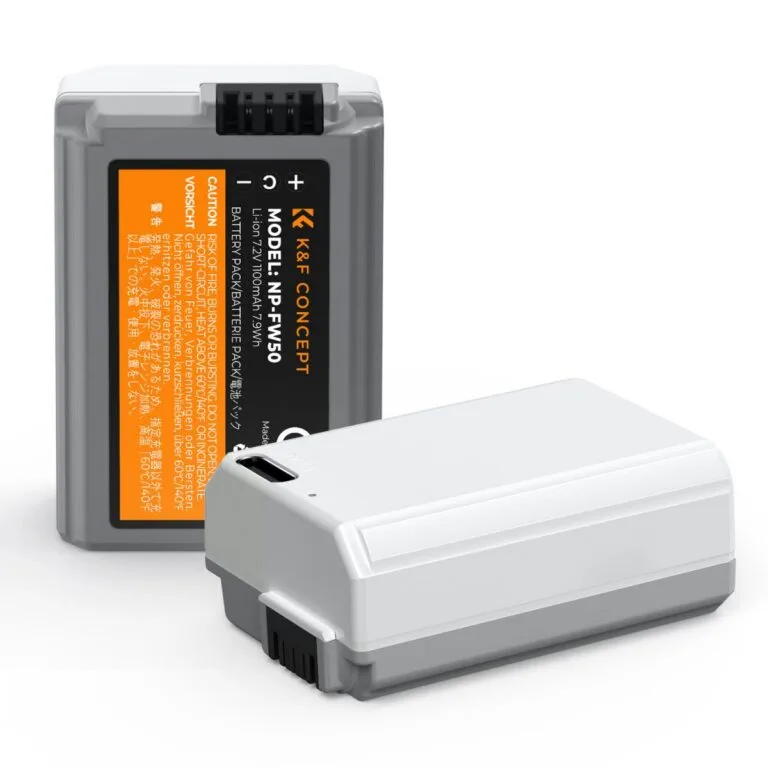
Short answer: 8.14Wh means long runtime is not on the table, so the plan should be “carry more cells and recharge them in parallel overnight” rather than hunting for a bigger one. Roughly 350 frames on an α6400 is a commonly quoted reference, but a live screen, frequent playback, flash, cold weather and video all pull it down. Two packs cover a travel day of a few hundred frames; video-first or long outdoor days call for three plus a two-slot charging case. Fixed-camera livestreaming needs external power. Our NP-FW50 is quoted at 1100mAh typical, 1050mAh rated, 7.4V and 8.14Wh; Sony’s original NP-FW50 is 1020mAh at 7.2V (7.3Wh).
What 8.14Wh actually means
Watt-hours measure energy: 7.4V × 1.1Ah ≈ 8.14Wh, matching our quoted figure. To estimate duration, divide that energy by the device’s average draw and allow for conversion loss. At an assumed 3W average and an efficiency of 0.8: 8.14Wh ÷ 3W ÷ 0.8 ≈ 3.4 hours. That is a powered-on estimate, not a frame count, and it leaves out playback, wake cycles and screen brightness changes.
Frame counts are more familiar but less precise. Roughly 350 frames on an α6400 is a common reference that assumes brief screen use, little playback and no flash. Shoot with the rear screen live, review every frame, or record 4K, and the same cell behaves quite differently. Treat it as an upper reference when planning spares, not a promise.
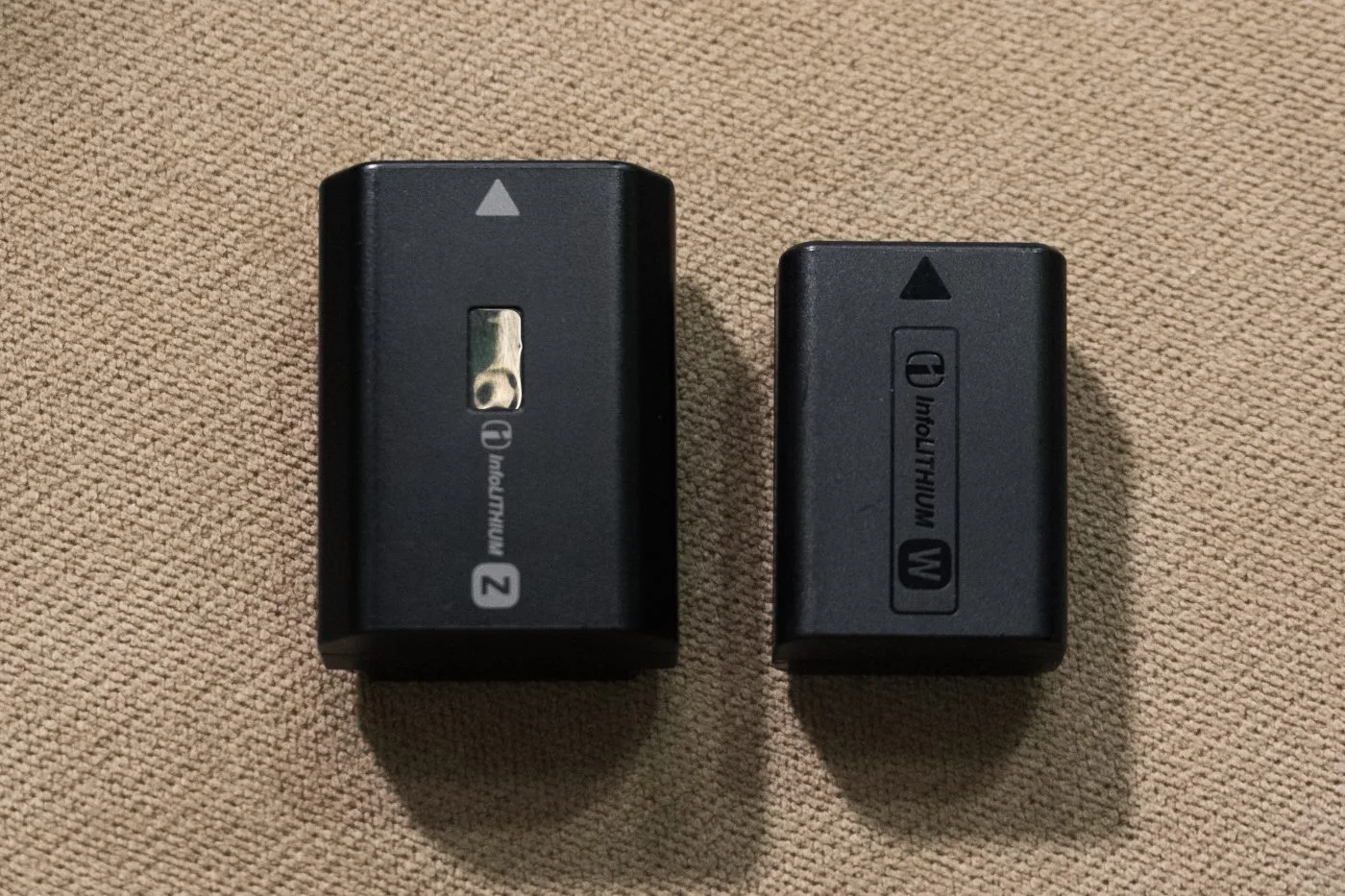
Capacity variants change little here. The original 1020mAh and our 1100mAh typical rating differ by about 80mAh, a small step at this energy level. To meaningfully extend a day out, adding a cell does far more than choosing between those two figures.
Work backwards from the day’s volume
The table divides by a uniform “about 350 frames per cell” baseline. These are planning estimates, not measured results. Video uses the roughly 3.4 hours derived above, and continuous recording usually comes in shorter because encoding and stabilisation draw power the whole time.
| Day’s volume | Energy needed | Suggested setup | Refill plan |
|---|---|---|---|
| About 200 stills, out for the day | Less than one cell | One in body, one spare | Charge one overnight |
| 350–700 stills, full travel day | One to two cells | Two cells, rotated | Charge both overnight |
| 700–1000 stills, or mixed video | Two to three cells | Three cells plus a two-slot case | Charge one first, swap before bed |
| All-day events, weddings, no sockets | Three or more cells | Three-plus, case, power bank | Top up a USB-C cell during the day |
| Livestream, time-lapse, fixed camera | Not applicable | DC coupler dummy battery on external power | Do not rely on swapping cells |
A charging case only starts to matter from the third row: its value is parallel overnight charging and closed-lid storage, not extra capacity in any single cell. The USB-C TNP-FW50 is most useful in the last two rows, where a power bank can refill it directly without removing it from the bag.
Fitting all three forms into one day
A workable cycle: put two cells in a DR-FW50 two-slot case the night before; run one in the body during the day with the other in the bag; if the level gets tight at midday, give the spare USB-C cell a top-up from a power bank; back at the accommodation, seat both in the case again. Standard cell, direct-charge cell and case each cover one stage — they are not substitutes.
Refill time can be estimated as 8.14Wh ÷ input power ÷ 0.8: about 2.0 hours at 5W, 1.4 hours at 7.5W and 1.0 hour at 10W. Because the energy is small, even charging two cells one after another often fits in an evening; genuine parallel charging matters when three or more cells must be ready by morning. Power figures are assumptions and results are estimates.
Specifications and kit options are on the NP-FW50 compatible battery page, with the direct-charge cell on the TNP-FW50 page and the case on the DR-FW50 page. Related writing on capacity, ageing and body fit is grouped under the NP-FW50 category.
Variables worth watching
Cold is the clearest enemy of a small cell like this: keep spares close to the body in winter and fit them only when needed. A permanently live screen and frequent playback steadily consume the modest 8.14Wh, so trim review time and wireless transfer where you can. Ageing shows up as a fast drop from full or sudden shutdown in the cold — that is the point to replace the cell rather than compensate by carrying one more.
One more compatibility check: FW50 covers α5000 through α6500, ZV-E10, the NEX range, α7 and α7 II, and RX10. From α7 III onward, and on α6600 / α6700, Sony moved to NP-FZ100; the two are not interchangeable. Careful spare planning is wasted if the cell itself is the wrong shape.
FAQ
How many more frames does 1100mAh give over the original 1020mAh?
There is no reliable fixed conversion. The quoted gap is about 80mAh, a small step at this energy level, and real frame counts are shaped far more by screen use, playback, flash, temperature and how much video you shoot. A consistent percentage gain is not something to expect.
How many packs for video-first work?
Start at three and add a two-slot case. At an assumed 3W draw a full cell estimates to about 3.4 hours, but continuous encoding and stabilisation usually shorten that. For long fixed-camera recording, go straight to external power.
Can a charging case replace buying another cell?
No. It charges and stores cells but adds no capacity to the day’s rotation. What it solves is refilling three or more cells in a single evening and carrying them without loose parts; usable energy still comes from the number of cells.
Are there flight restrictions?
Standard practice is to keep lithium cells in carry-on luggage with terminals insulated, avoid checked baggage, and follow the airline’s limit on spare batteries. Check your carrier’s current rules before departure; this is unrelated to whether the cell has a USB-C port.