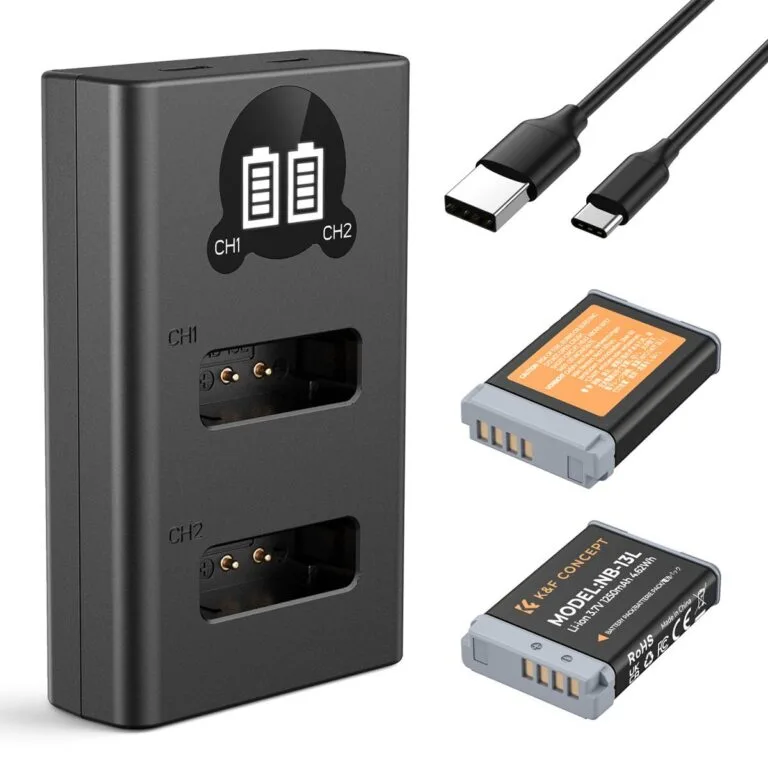
Canon G7 X III topping up when the only charger is the body
The Canon G7 X III runs on the NB-13L (4.5 Wh). The published figures are 235 stills and 90 minutes of continuous recording, but both assume one cell at room temperature. This article answers one question only: Canon G7 X III topping up when the only charger is the body. We put the rated numbers, the measured power draw and the pack energy side by side and worked out the figures you can plan with.
Run the numbers for your shooting
Start by converting the published figures into power draw. The Canon G7 X III pulls about 2.1 W while shooting stills and 2.4 W while recording. The NB-13L holds 4.5 Wh, so:
| Item | Value |
|---|---|
| Stills at 2.1 W | about 2 h, i.e. 118 frames |
| Continuous recording at 2.4 W | about 90 min |
| Published rating | 235 stills / 90 min video |
The gap between the two sets comes from test conditions. The CIPA stills figure assumes intermittent viewing and one frame every 30 seconds, while the power calculation assumes the camera is awake the whole time. Real use lands between them: the denser your shooting, the closer you get to the upper number; the longer the idle stretches, the closer to the lower.
With the battery fitted the body weighs 304 g. A spare NB-13L adds only about 5 g, which makes it the cheapest insurance in any endurance plan.
What the cold takes away
A lithium pack loses 15-25% of usable capacity around 0 C and 30-40% at -10 C. At the 2.4 W recording draw of the Canon G7 X III, the same 4.5 Wh behaves like 2.7 Wh, and continuous recording drops from 90 minutes to about 68. Pack for the winter number, not the brochure one.
Three real scenarios
Battery needs for three real situations (derived from the draw above, with 20% headroom):
| Item | Value |
|---|---|
| Half-day of stills (3 h) | 2 x NB-13L |
| Full day mixed (5 h, 40 min of video) | 5 x NB-13L |
| Recording-led day (6 h of video) | 5 x NB-13L |
On location, budget the power in two buckets: recording stretches and standby stretches. Recording always gets a full cell; standby can run on a half-empty one. Done that way, 5 cells still cover a full mixed day.
Charging and topping up
A full charge from empty takes about 100 minutes with the official charger. This body cannot run from USB PD while in use, so topping up only happens with the camera off. Buy the whole day’s capacity up front instead.
Battery specifications
| Item | Value |
|---|---|
| Battery | NB-13L |
| Rated capacity | 1250 mAh |
| Voltage | 3.6 V |
| Energy | 4.5 Wh |
Key figure:microUSB
Frequently asked questions
How long does one NB-13L last in this camera?
About 2 hours or 118 frames of stills, and roughly 90 minutes of continuous video. Cold weather or high frame rates cut that noticeably.
What is the minimum number of cells for the Canon G7 X III?
For a mixed full day, 5 is the safe line; on a recording-led day plan for 5.
Can I use third-party NB-13L cells?
As long as the rated capacity matches the NB-13L and the pack has over-current protection, yes. Some bodies will not show a percentage on non-OEM cells, which is a display issue, not a power one.
What happens to a cell that sits unused?
Storing a lithium pack at full charge accelerates ageing. Keep it near 50% and top it up every three months. Once it falls below 70% of rated capacity, retire it.
Choosing the right cell
Three things matter when buying a NB-13L: whether the rated capacity really reaches 1250 mAh, whether it has over-current and over-temperature protection, and whether the body will read its percentage. Overspecced cells sag early and shut this camera down.
Bottom line
In one line: the Canon G7 X III uses the NB-13L, giving about 2 hours of stills or 90 minutes of continuous recording per cell. Carry 5 to 5 depending on your pace, add one for winter, and the kit is complete.
Sources: manufacturer published CIPA ratings and this body’s power figures. Real results vary with temperature, settings and shooting rhythm.