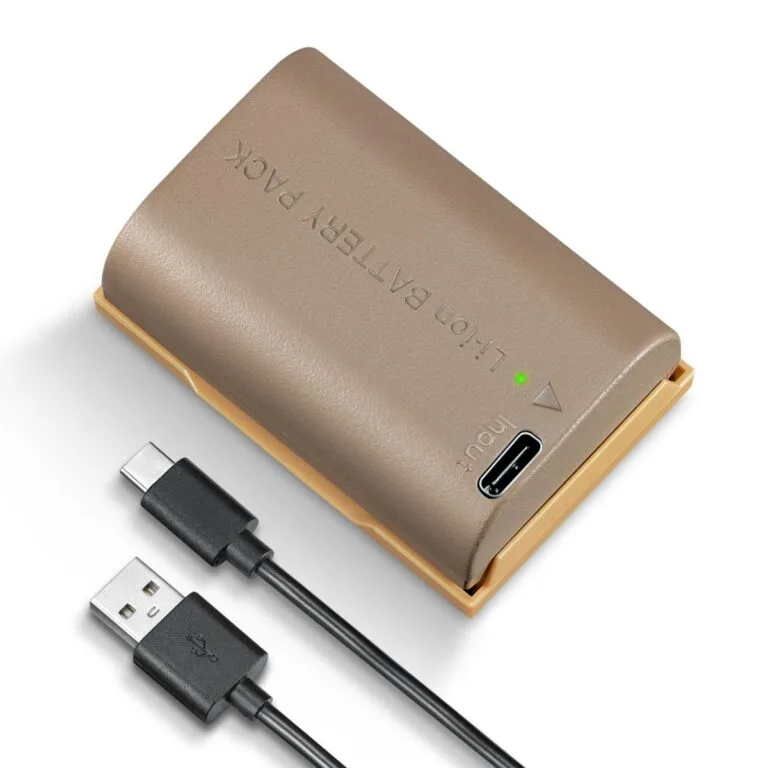
Canon EOS R5 old LP-E6 cells in the R5
The Canon EOS R5 runs on the LP-E6 (13.4 Wh). The published figures are 490 stills and 150 minutes of continuous recording, but both assume one cell at room temperature. This article answers one question only: Canon EOS R5 old LP-E6 cells in the R5. We put the rated numbers, the measured power draw and the pack energy side by side and worked out the figures you can plan with.
Run the numbers for your shooting
Start by converting the published figures into power draw. The Canon EOS R5 pulls about 3.3 W while shooting stills and 6.5 W while recording. The LP-E6 holds 13.4 Wh, so:
| Item | Value |
|---|---|
| Stills at 3.3 W | about 4.1 h, i.e. 245 frames |
| Continuous recording at 6.5 W | about 150 min |
| Published rating | 490 stills / 150 min video |
The gap between the two sets comes from test conditions. The CIPA stills figure assumes intermittent viewing and one frame every 30 seconds, while the power calculation assumes the camera is awake the whole time. Real use lands between them: the denser your shooting, the closer you get to the upper number; the longer the idle stretches, the closer to the lower.
With the battery fitted the body weighs 738 g. A spare LP-E6 adds only about 5 g, which makes it the cheapest insurance in any endurance plan.
What the cold takes away
A lithium pack loses 15-25% of usable capacity around 0 C and 30-40% at -10 C. At the 6.5 W recording draw of the Canon EOS R5, the same 13.4 Wh behaves like 8 Wh, and continuous recording drops from 150 minutes to about 74. Pack for the winter number, not the brochure one.
Three real scenarios
Battery needs for three real situations (derived from the draw above, with 20% headroom):
| Item | Value |
|---|---|
| Half-day of stills (3 h) | 1 x LP-E6 |
| Full day mixed (5 h, 40 min of video) | 2 x LP-E6 |
| Recording-led day (6 h of video) | 3 x LP-E6 |
On location, budget the power in two buckets: recording stretches and standby stretches. Recording always gets a full cell; standby can run on a half-empty one. Done that way, 2 cells still cover a full mixed day.
Charging and topping up
A full charge from empty takes about 150 minutes with the official charger. The body supports USB PD, so a power bank can top it up between takes. When it is running off external power the load is shared and you get roughly 30% more shooting time.
Battery specifications
| Item | Value |
|---|---|
| Battery | LP-E6 |
| Rated capacity | 1865 mAh |
| Voltage | 7.2 V |
| Energy | 13.4 Wh |
Key figure:兼容但性能受限
Frequently asked questions
How long does one LP-E6 last in this camera?
About 4.1 hours or 245 frames of stills, and roughly 150 minutes of continuous video. Cold weather or high frame rates cut that noticeably.
What is the minimum number of cells for the Canon EOS R5?
For a mixed full day, 2 is the safe line; on a recording-led day plan for 3.
Can I use third-party LP-E6 cells?
As long as the rated capacity matches the LP-E6 and the pack has over-current protection, yes. Some bodies will not show a percentage on non-OEM cells, which is a display issue, not a power one.
What happens to a cell that sits unused?
Storing a lithium pack at full charge accelerates ageing. Keep it near 50% and top it up every three months. Once it falls below 70% of rated capacity, retire it.
Choosing the right cell
Three things matter when buying a LP-E6: whether the rated capacity really reaches 1865 mAh, whether it has over-current and over-temperature protection, and whether the body will read its percentage. Overspecced cells sag early and shut this camera down.
Bottom line
In one line: the Canon EOS R5 uses the LP-E6, giving about 4.1 hours of stills or 150 minutes of continuous recording per cell. Carry 2 to 3 depending on your pace, add one for winter, and the kit is complete.
Sources: manufacturer published CIPA ratings and this body’s power figures. Real results vary with temperature, settings and shooting rhythm.