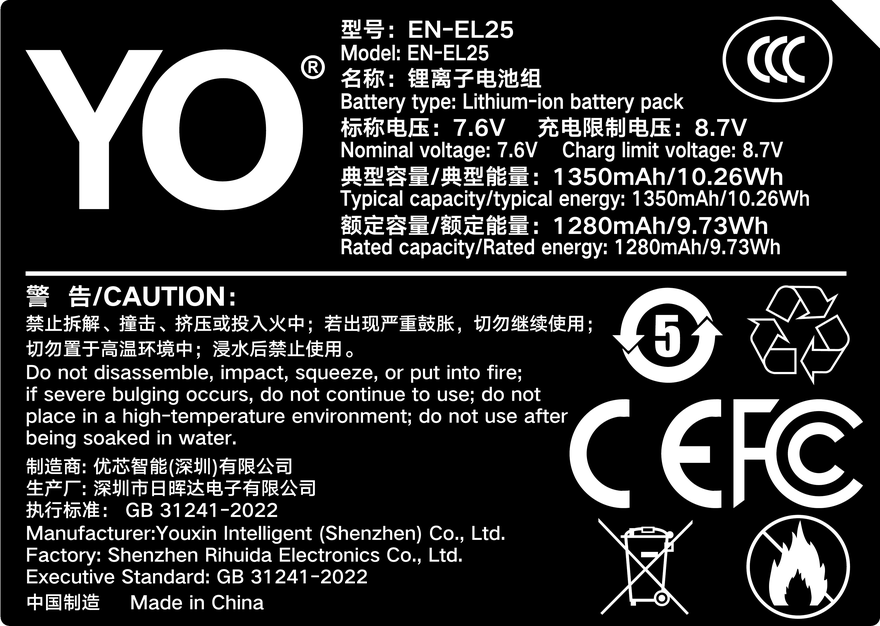
Direct answer: on estimates, one 10.26Wh EN-EL25 compatible battery records roughly 2 hours at a 5W total draw, or about 1.3 hours at 8W. CIPA photo ratings cannot be applied to video; video runtime should be calculated from power draw. For a full day of 4K, plan on around five batteries. All durations below are paper estimates, not measured results.
CIPA shot counts and video runtime are different things
The most common battery figure is the CIPA photo rating: under a standardized test routine of half-presses, playback and power cycles, how many shots one battery delivers. That is useful for “will one battery cover a day of stills”, but nearly meaningless for video.
The reason is that video works completely differently: sensor, processor and screen run at full load continuously, with none of the stills shooting’s pauses. Meanwhile many of the biggest power consumers in the CIPA routine — constant focusing, playback, restarts — never happen during video. The correct approach for video is to calculate from power: battery energy divided by total draw gives the approximate recording time.
What 10.26Wh buys you: the math
The EN-EL25 compatible battery covered here has a typical energy of 10.26Wh (rated 9.73Wh). There is no single official figure for total camera draw, so two common estimate levels are used below. Emphasizing again: these are estimates, and real times will drift with temperature, resolution, stabilization and shooting habits.
- At a 5W draw: 10.26Wh ÷ 5W ≈ 2.05, roughly 2 hours of recording.
- At an 8W draw: 10.26Wh ÷ 8W ≈ 1.28, roughly 1.3 hours (about 77 minutes) of recording.
The gap between the two levels is more than half an hour, which is exactly why “video runtime” is not one fixed number. The direction of experience: 1080p, low screen brightness and intermittent shooting lean toward the 5W level; 4K, full stabilization and continuous takes lean toward — or beyond — 8W. For conservative planning, use the 8W level across the board.
Clip limits and overheating
Even with battery to spare, a single clip can be cut short by two factors. The first is heat: video recording heats the body continuously, and in warm surroundings or at high-bitrate 4K the camera may warn of overheating and restrict recording earlier than expected. That has nothing to do with the battery, but it directly compresses the real runtime per battery. The second is routine limits: some bodies impose a maximum length per clip and split recordings automatically. Splitting itself costs no extra power, but idle drain between segments still counts.
The countermeasures are ordinary: let the body cool between takes, lower screen brightness, and switch stabilization off when it is not needed. None of these add capacity, but they help actual recording time approach the estimate.
How many batteries a shooting day needs
Applying the math above to a shooting schedule gives the table below. The principle is to err on the generous side, because cold weather and battery aging both push real runtime below estimates.
| Shooting type | Approximate draw | Batteries needed |
|---|---|---|
| A day of mostly stills | CIPA basis, well below video | 1 in body + 1 spare |
| Half a day of 1080p video (about 4 hours) | 5W estimate: 10.26Wh ÷ 5W ≈ 2 hours per battery | 2 |
| Half a day of 4K video (about 4 hours) | 8W estimate: 10.26Wh ÷ 8W ≈ 1.3 hours per battery | 3 |
| A full day of 4K video (about 8 hours) | Same 8W estimate | About 5 |
Err toward carrying more spares: at ¥131.40 per battery for the EN-EL25 compatible model covered here, an extra two or three is not a large cost. Product details are on the product page, and charging and power options for the same bodies are summarized in the category page.
FAQ
Why does the official runtime differ from my calculation?
Official figures use their own test conditions and power assumptions — a different basis from the 5W / 8W estimates here. The two can only be compared directionally, not converted.
Can USB power while recording fully replace spare batteries?
No. Power during recording is unavailable on some bodies, and heat plus the risk of a power drop make it fragile. Treat external power as a supplement and battery rotation as the backbone.
Rated 9.73Wh is less than the typical 10.26Wh — which should I use?
The typical value reflects ideal conditions; the rated value is closer to the guaranteed floor. For conservative planning use 9.73Wh, which at 8W gives about 1.2 hours.
Should I carry extra batteries in cold weather?
Cold noticeably reduces usable capacity. For outdoor winter shooting, carry at least one battery beyond the table and keep spares close to your body for warmth.