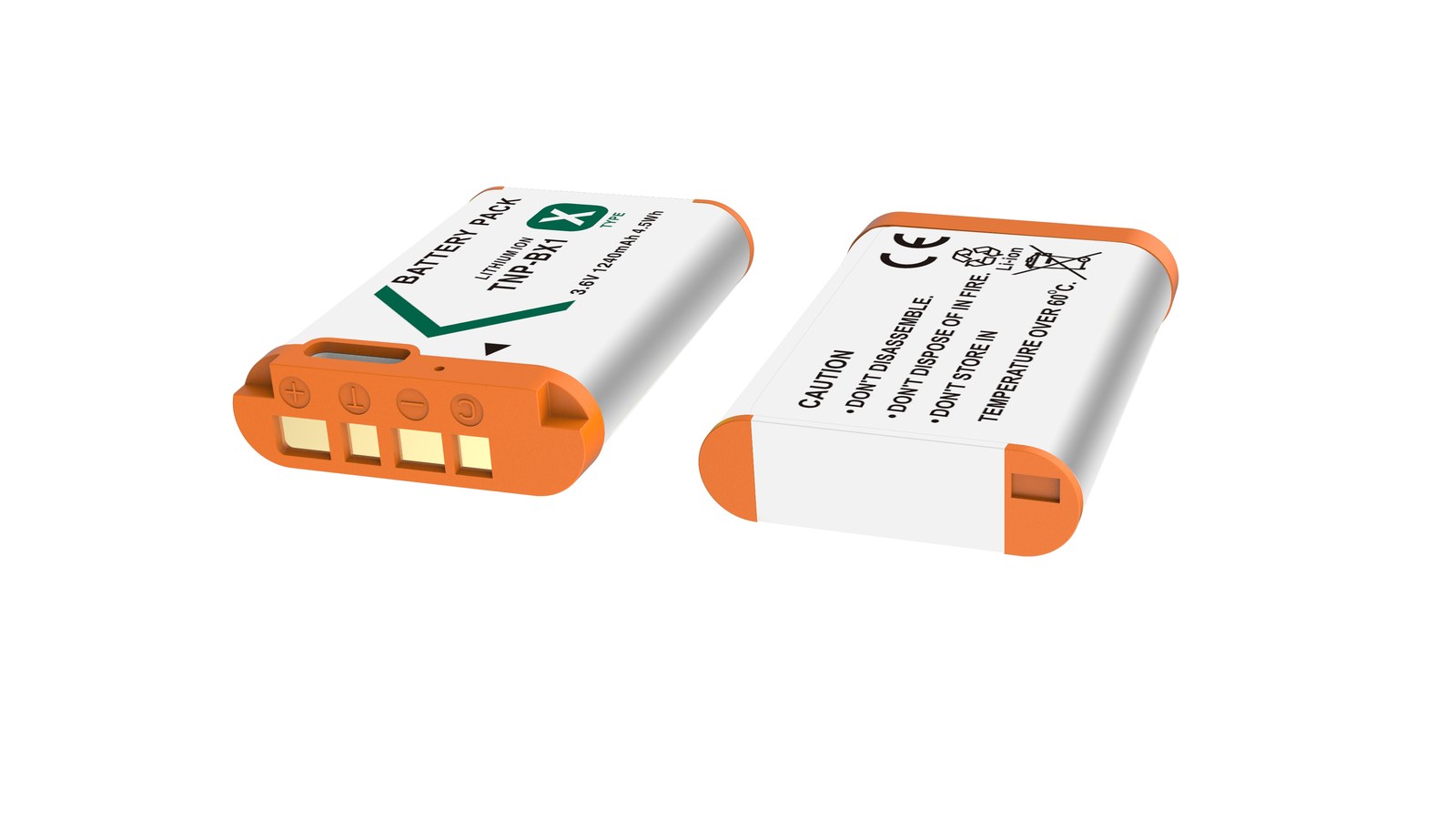
Short answer: a dedicated dock charger fills an NP-BX1 fastest. In-camera USB charging is the emergency route, it is slower and it ties up the camera. A power bank changes where you charge, not how fast. The pack holds 1090mAh typical and 1060mAh rated at 3.7V, which is 4.04Wh typical and 3.93Wh rated. With that little energy the absolute gap between the three methods is a few tens of minutes. What really decides your day is whether the camera stays free while a battery refills.
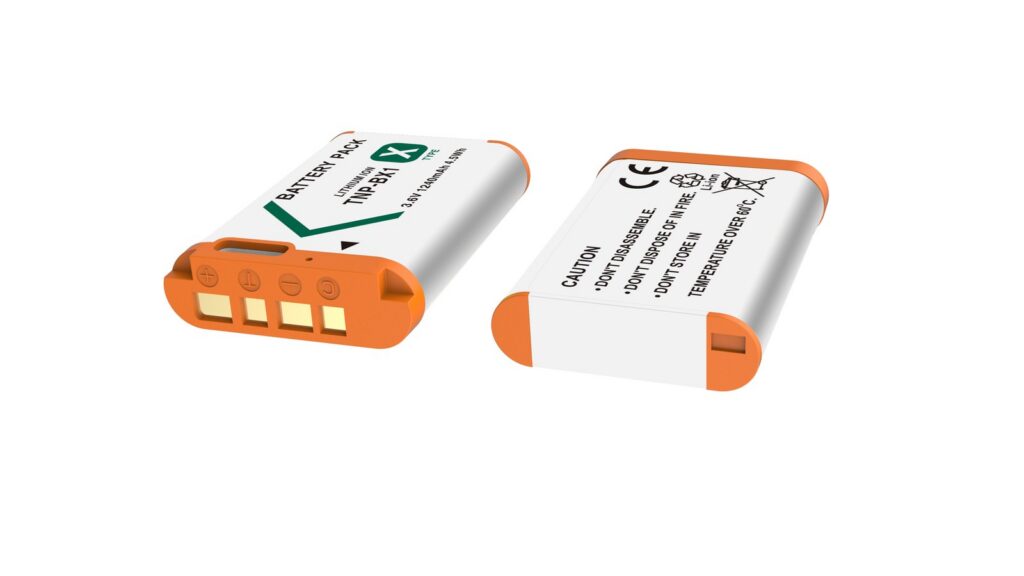
Where the three methods actually differ
In-camera charging hands the job to the camera’s own power circuit. That circuit is deliberately conservative. It limits current to keep the body and the pack from heating, and on most models it expects the camera to be switched off. The same battery can take different times to fill in different bodies, because each model’s charging circuit is designed differently.
A dock charger skips the camera entirely. It converts 5V down to a constant 4.2V and feeds the cell directly, so the current can be set slightly higher and nothing competes for the camera’s attention. The trade-off is bulk. It is one more item in the bag, and on most kits the dock is sold separately.
A power bank is a 5V supply you can carry. The current still passes through the camera’s charging circuit or a USB dock, so the ceiling stays where it was. Buy one for capacity and convenience, not for speed.
Estimating the times, and the arithmetic behind them
The numbers below are estimates built from nameplate output and a 70 to 85 percent conversion efficiency. They are not measurements. The formula is pack energy divided by output voltage times output current times efficiency.
- Dock at 4.2V and 0.6A gives 2.52W. At 0.8 efficiency that is about 2.0W, and 4.04Wh divided by 2.0W is roughly 2.0 hours.
- In-camera at 5V and 0.5A gives 2.5W. At 0.7 efficiency that is about 1.75W, and 4.04Wh divided by 1.75W is roughly 2.3 hours.
Add ten to twenty minutes for the constant-voltage tail and the camera’s own idle draw. That puts a dock at about 1.8 to 2.1 hours and in-camera charging at 2.3 to 2.6 hours, which is close to what most people see in daily use.
| Method | Best for | Rough time (estimate) |
|---|---|---|
| Dedicated dock (4.2V / 0.6A) | Home, hotel, overnight top-ups | 1.8–2.1 hours |
| In-camera USB | Forgotten charger, emergencies | 2.3–2.6 hours |
| Power bank into the camera | Travel and outdoor shoots without an outlet | 2.3–2.6 hours, limited by the camera |
| Power bank into a USB dock | Trains, airports, camping | 1.8–2.1 hours, depends on the dock input |
Habits worth keeping
Lithium packs have no memory effect, so there is no reason to run one flat before charging. Topping up at one bar is fine. The two things that genuinely shorten life are leaving a pack discharged for months and charging it hot.
If the body or the pack becomes properly hot to the touch, stop. Warm is normal during in-camera charging, uncomfortable is not. Do not leave batteries in a parked car in summer, and do not charge a cold pack straight from outdoors. Let it return to room temperature first.
Unplug when the charger says full. The protection board cuts off at 4.2V, so leaving it connected longer adds nothing except time spent in a warm place.
This is where a cheap pack earns its place. At ¥24.57 each, three cost less than a meal. Swapping a battery takes ten seconds, while waiting at a charging point takes half an hour you would rather spend shooting.
How many to carry
For a travel day of two or three hundred frames plus the occasional clip, two packs are usually enough. If video is the main thing, four is safer. You can check the figures on the NP-BX1 compatible battery page, or compare other packages under Sony NP-BX1 batteries.
One point of honesty. The 1090mAh typical figure is below Sony’s roughly 1240mAh nominal rating for the original. The gap comes from how the numbers are quoted, rated versus typical, and from headroom reserved by the protection board. A third-party pack earns its place on price and on how many spares you can afford, not on extra capacity.
FAQ
Can in-camera USB charging damage the camera?
With the charger specified in the manual, or any compliant 5V supply, it is generally fine. The real risks are unstable output from a poor charger and sustained heat from shooting while charging. Switch the camera off while it charges.
Does the dock have to be an original Sony one?
No. A dock only has to convert 5V into a constant 4.2V with a proper cut-off, and that is not difficult to do well. Check that the rated output says 4.2V. Do not use a two-cell 8.4V charger on a single pack.
How many charges can a power bank deliver?
By energy, a 10000mAh bank is about 37Wh nominal. After conversion losses roughly 25 to 28Wh is usable, and dividing by 4.04Wh gives around six charges. That is a theoretical estimate. Cables, temperature and camera idle draw all take a cut.
Is it bad to unplug before the battery is full?
No. Shallow cycles wear a lithium cell less than deep ones, so charging whenever convenient is normal use. There is no need to run it down first.