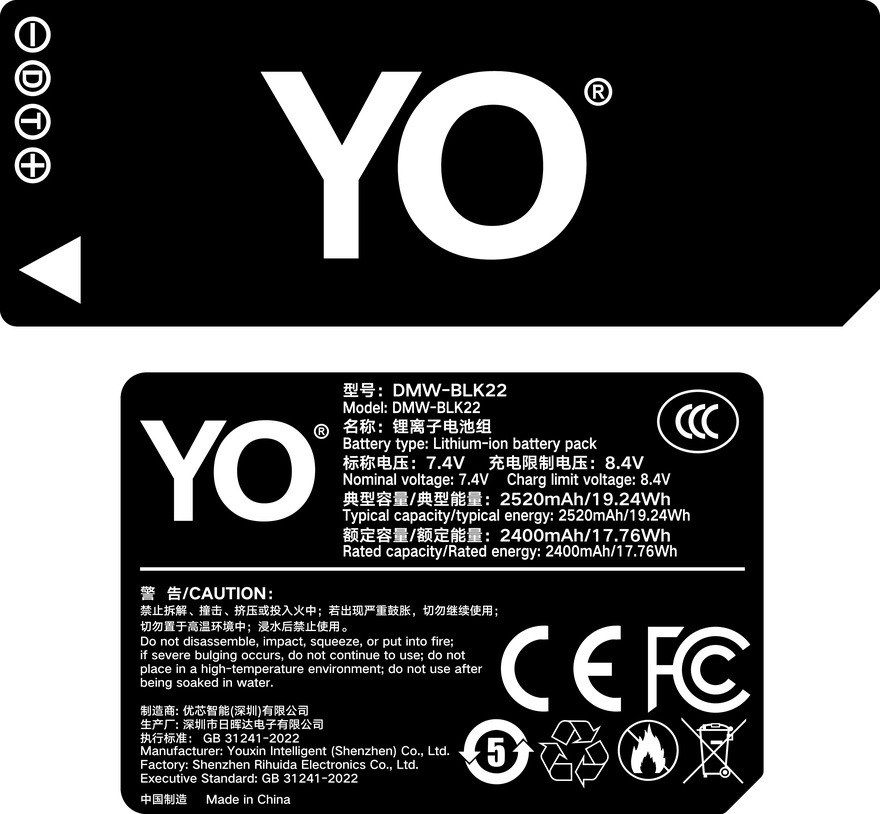
Short answer: in-camera USB-C PD is the fastest route at about 1.3 hours on an 18W supply. A single-bay dock takes roughly 2.9 hours but leaves the camera free. A two-bay charger does not fill one pack faster, it fills two at once, and that is what makes it worth buying for video work. This compatible pack is quoted at 2520mAh and 7.4V, 19.24Wh, with a 2400mAh and 17.76Wh rating. That is enough energy for the gap between methods to be measured in hours rather than minutes, so the wrong choice really does shape the next day of shooting.
Three routes, three different circuits
In-camera charging hands the job to the camera’s own power management. The Lumix S5 II generation supports USB-C PD, negotiates a 9V rail from the supply and keeps running while the cable is attached. The body caps how much it draws, usually around 18W, and while recording it diverts part of that to the sensor and screen, so charging is slower than it is with the camera switched off.
A dock charger bypasses the camera. It lifts the input to 8.4V and feeds the two series cells with constant current then constant voltage. It does not care what the camera is doing, so the current can be set a little higher. The cost is another box in the bag, and on most kits the dock is sold separately.
A two-bay charger is simply two independent single-bay circuits in one shell. It does not make one pack fill faster. It starts two at the same time. Get that clear before buying, because it is easy to pay for the wrong expectation. The pack fits the S5, S5 II, S5 IIX, G9 II, GH5 II, GH6 and GH7. The S1, S1R and S1H take DMW-BLJ31, the GH5 and GH5S take DMW-BLF19, and the G series takes DMW-BLG10.
Estimate the time, do not guess it
Every figure below is an estimate built on one formula: 19.24Wh divided by input power divided by 0.8, where 0.8 covers conversion losses in the charging circuit and the dock. Real times run a little longer because of the constant-voltage tail, camera idle draw and ambient temperature.
- 18W PD: 19.24 / 18 / 0.8 is about 1.3 hours.
- 10W at 5V and 2A: 19.24 / 10 / 0.8 is about 2.4 hours.
- 8.4W dock at 8.4V and 1.0A: 19.24 / 8.4 / 0.8 is about 2.9 hours.
| Method | Assumed input | Estimated full charge | Best for |
|---|---|---|---|
| In-camera USB-C PD | 18W on the 9V rail | About 1.3 hours | Hotels, charging while shooting, top-ups |
| In-camera USB at 5V/2A | 10W | About 2.4 hours | Laptop ports, car, emergencies |
| Single-bay dock | 8.4W at 8.4V/1.0A | About 2.9 hours | Home, overnight charging |
| Two-bay dock | About 17W, 8.4W per bay | About 2.9 hours each, in parallel | Multiple packs, night before a shoot |
| 30W PD bank into the camera | 30W, capped by the body | About 1.3 to 1.6 hours | Location work with no outlet |
One note on the last row. A bank rated at 30W does not mean the camera swallows 30W. The body has an intake ceiling, so the extra wattage is headroom, not a proportional cut in time.
Choosing a PD charger
Look at the protocol first, not the wattage. It has to be USB PD with a 9V step. An old 5V/2A brick will charge, only slowly. Then look at power. 18W is the entry point and a 30W single port is more comfortable, especially if you want to shoot while charging or feed a two-bay dock from one head.
Then look at the cable. A USB-C to C cable should be rated for 3A or more, and one with an e-marker is steadier. A good share of slow-charging complaints trace back to the cable rather than the head. Finally, count the ports. On a dual-port head the total is shared, so a 65W unit may deliver only 30W per port when both are in use.
Can you shoot while charging? The S5 II supports PD pass-through, so the supply runs the body and tops the pack at the same time. The body does get warmer, and that shows up during long 4K takes. Outdoors in summer, pull the battery and use a dock so the camera can shed heat.
Why video shooters need two bays
Run the numbers. Four packs, one evening, three hours. On a single bay the first pack takes 2.9 hours and the fourth waits until morning, so you finish with a little more than one. Two bays working in parallel complete two rounds in the same three hours, which covers all four.
The second benefit is status. Each bay has its own indicator, so you can see at a glance which pack is full and which is still working, and you stop mixing half-empty cells into the bag. You can check the figures on the DMW-BLK22 compatible battery page, or compare packs under Panasonic DMW-BLK22 batteries. The original Panasonic DMW-BLK22 is quoted at about 2200mAh and 16Wh. The compatible pack is slightly higher on paper, but the charging arithmetic is the same, so the table above still applies.
FAQ
Can in-camera PD charging damage the camera?
With a PD supply that meets the manual’s specification, or any compliant USB PD source, it is generally fine. The real risks are unstable output from a poor charger and sustained heat from shooting while charging. Switch the camera off when you can.
Will a two-bay charger work with original Panasonic packs?
Yes. A dock only responds to voltage and the charge curve, and both the original and the compatible pack are 7.4V nominal with an 8.4V cut-off. The charger must be built for the DMW-BLK22 format, so do not force a dock made for another model.
Can I buy any charger and cable
The head needs USB PD with a 9V step, and the cable needs a 3A rating. Meet those two and charging will not be oddly slow. Buying on the word fast alone often lands you on a 5V-only unit.
Is it a problem to leave the pack on the charger at 100%
The protection board cuts off at 8.4V, so a few extra hours will not overcharge it, but the pack sits warm for that time. Unplugging when the light says full is the better habit, and it matters more for packs you store.