A NP-F960 can be topped up via Dual Dock / AC / D-tap: a dock for home, a power bank on location, and external power only for long takes. Charging efficiency depends heavily on temperature, so pause below 5°C or above 40°C. Mild warmth is normal; a pack that is hot to the touch, smells unusual or has deformed should be disconnected immediately. For long storage keep about 50% charge and top up every three months.
Key specifications and limits: 5 W 7 h / 15 W 2.5 h / 38.9 Wh. Actual figures vary with resolution, frame rate, screen brightness and ambient temperature, so plan spares around the shortest figure in the table.
Three charging paths compared
The paths differ mainly in speed and whether the cell has to come out. A dock is stable and can charge two at once; in-body USB is convenient but usually stops charging when the camera is powered on; a power bank covers location work.
Method
Note
Dual Dock
Stable, charges two cells at once, best for home or studio rotation
AC
No need to remove the cell, ideal for travel, but charging usually stops when powered on
D-tap
Good for location top-ups; check output specs and cable quality
Temperature and storage limits
Charge between 5–40°C, and store around 15–25°C in a dry place at roughly 50% charge. Leaving a pack fully charged or completely flat for months accelerates capacity loss.
Item
Value
NP-F960
NP-F550 / F750 / F960 / F970
NP-F970
Sony NP-F960
np-f960
5400 mAh / 38.9 Wh
NP-F960
5 W 7 h / 15 W 2.5 h / 38.9 Wh
α7 / α9 → NP-FZ100 / F750
NP-F550 / F750 / F960 / F970
NP-F550 / F750 / F960 / F970
5400 mAh / 38.9 Wh
Power for long recordings
For long takes, streaming or time-lapse, prefer external power and watch the heat. Charging while the camera runs keeps the cell warm, so leave room for ventilation in summer or in enclosed spaces.
To pick by model, start with the specifications and stock status on Sony NP-F960 5400mAh, then browse the full article set in NP-F960; if your body belongs to a neighbouring system, NP-BX1 has the side-by-side explanation.
FAQ
Can the NP-F960 be charged inside the camera?
It depends on the body: Dual Dock / AC / D-tap. Where in-body USB charging is supported, it normally stops as soon as the camera is switched on, so a dock is more predictable when you are in a hurry.
How long does a full charge take?
It varies with charger output, remaining charge and ambient temperature. A dock is usually the fastest and most stable option, while in-body USB and power banks are slower. Use the charger indicator rather than the in-camera percentage as your guide.
Can I shoot while charging?
External power is fine for long recordings or streaming, but body and cell both stay warm. In summer or enclosed spaces, improve ventilation and never put a hot pack straight into a sealed case.
How should I store the cell long term?
Keep it around 50% charge in a dry place at 15–25°C and top it up every three months. Long periods fully charged or fully flat accelerate ageing; recycle a swollen pack instead of recharging it.
The Sony A9 III runs on the familiar NP-FZ100, interchangeable with the A9, A9 II, A1 and the A7 line. But a speed body asks something different of its batteries than a general-purpose camera does. Beyond total capacity, it needs a cell that can deliver high current steadily: fast bursts, pre-capture and rapid buffer writes pull sharp spikes, and a tired cell can trip protection and shut the body down mid-frame.
Product render of the YO NP-FZ100 compatible battery: front label, rear LED charge indicator and USB-C port.
So the strategy here is redundancy, freshness and rotation. Carry three or four cells as a primary set, put the lowest-cycle packs in for critical jobs, and consider the 2600mAh NP-FZ100 (USB-C) for extra slack.
Why Speed Bodies Drain Faster
The A9 line is built around throughput, and the draw concentrates in a few places:
High-speed bursts. Dozens of frames per second keep the sensor and processor fully loaded while the shutter, stabilization and AF system cycle at high frequency.
Pre-capture. Buffering frames before you press the shutter means the body maintains continuous read and write activity — a steady background cost.
Buffer flush. After a burst, the body keeps running hard while data writes to the card; draw does not fall off instantly.
Constant EVF use. Sports and wildlife work means live electronic viewing for long stretches, which loads both panel and sensor readout.
Fast transfer. News workflows push files over wireless in the background, adding another steady draw.
Net effect: hourly consumption runs clearly above a comparable general-purpose body. Do not plan this one using standard-body runtime habits. Under heavy use, budget roughly one cell per one to two hours.
Battery Commonality Across the A9 Line
The A9, A9 II, A9 III and A1 all take the NP-FZ100, which simplifies kit management: one pool of cells and chargers moves across the flagship bodies. The caveat is that these bodies are not equally demanding. Putting a heavily worn cell in an A9 III raises the odds of trouble. A graded approach works better: healthy cells go to the speed bodies, visibly worn ones drop down to an A7 series body or a backup shell.
What Burst Shooting Demands Beyond Capacity
High-current delivery
Capacity in mAh tells you how much energy a cell holds. Speed bodies care how fast it comes out. As a cell ages, internal resistance rises: it may still read 80 percent capacity, but voltage sags badly under load and the body reads that as empty. That is the classic “two bars showing, black screen the moment I burst” complaint.
Voltage stability
The NP-FZ100 is nominally 7.2V, and bodies enforce a low-voltage cutoff. Fresh cells sag less under burst load; old ones sag more and hit protection early. Practically, that means replacing cells more often than a casual shooter would.
Temperature stacking
Burst shooting generates its own heat, and add summer sun and the cells work hot, which cuts capacity and accelerates aging. Winter sidelines go the other way: below about 32°F capacity drops noticeably, and near 14°F you may get roughly half. Rotation and temperature management are the answer at both ends.
Cell Counts by Assignment
Assignment
Cells
Capacity
Typical spend
Sports, single 2–4 hour event
4 + dual charger
2600mAh preferred
Two two-cell kits, from about $79.84
News / event documentary
3
Mix 2600mAh and 2600mAh
About $39.92 plus about $17.89
Wildlife / birds
3–4 (long standby)
2600mAh
From about $39.92, add singles
Everyday / training
2
2600mAh is fine
About $36.74 for two with charger
Build your kit: the NP-FZ100 is 2600mAh / 7.4V / 19.24Wh. Battery only, battery plus charger, or two batteries plus charger — pick under Bundle. If you would rather leave the dock at home, the same-capacity USB-C version (2600mAh / 7.2V / 18.72Wh) charges from any phone charger. Bulk orders: wholesale enquiry.
Field Rotation and Management
Start full. Charge everything the night before a key assignment; do not roll in hoping it is enough.
Number and rotate. Track cells and their cycle counts, use the freshest first, and put swaps straight onto the charger to keep a flow going.
Swap early. Change during a lull rather than at the decisive moment, and do it at around two bars instead of waiting for the warning.
Keep them warm. Spares in an inner pocket, loaded right before use. It noticeably reduces cold-weather drop.
Prevent shorts. Terminal covers or individual slots per cell, no coins or keys in the same pouch, and always carry-on when flying.
Retire on schedule. Cells hold roughly 80 percent after 300 to 500 cycles. On speed bodies, be stricter: demote or replace anything clearly down.
FAQ
Will A7 III cells work in the A9 III?
Yes, both take the NP-FZ100. Condition matters though — speed bodies are sensitive to discharge capability, so give the A9 III your freshest packs.
Is a mid-burst shutdown a battery issue?
Usually. Rising internal resistance causes voltage sag under load, which trips protection. Verify by comparing against a low-cycle cell; if a fresh one behaves the same, look at the body and card instead.
Can compatible cells handle high-speed bursts?
A properly specified pack — 7.2V, correct dimensions and contacts — supports burst loads in normal use. Run a test burst before anything important to confirm stability in your own body.
How often should I replace the set?
Use the 300 to 500 cycle curve as the guide. Speed bodies see heavier use, so real replacement tends to come more often than for general shooting, with two years being a common point.
Bottom Line
Power for the A9 III comes down to three things: carry spares, keep cells fresh, and manage them. Both versions carry the same 2600mAh, so burst headroom is identical; the NP-FZ100 (USB-C) recharges from a phone charger, the NP-FZ100 is the cheaper workhorse, and both share the same chargers. For long takes and video-style recording, see FX3 and FX30 power setups; for the wider genuine-versus-compatible trade-off, see NP-FZ100 genuine vs third-party. Sports media and event teams buying 100 units or more can request pricing via our wholesale inquiry.
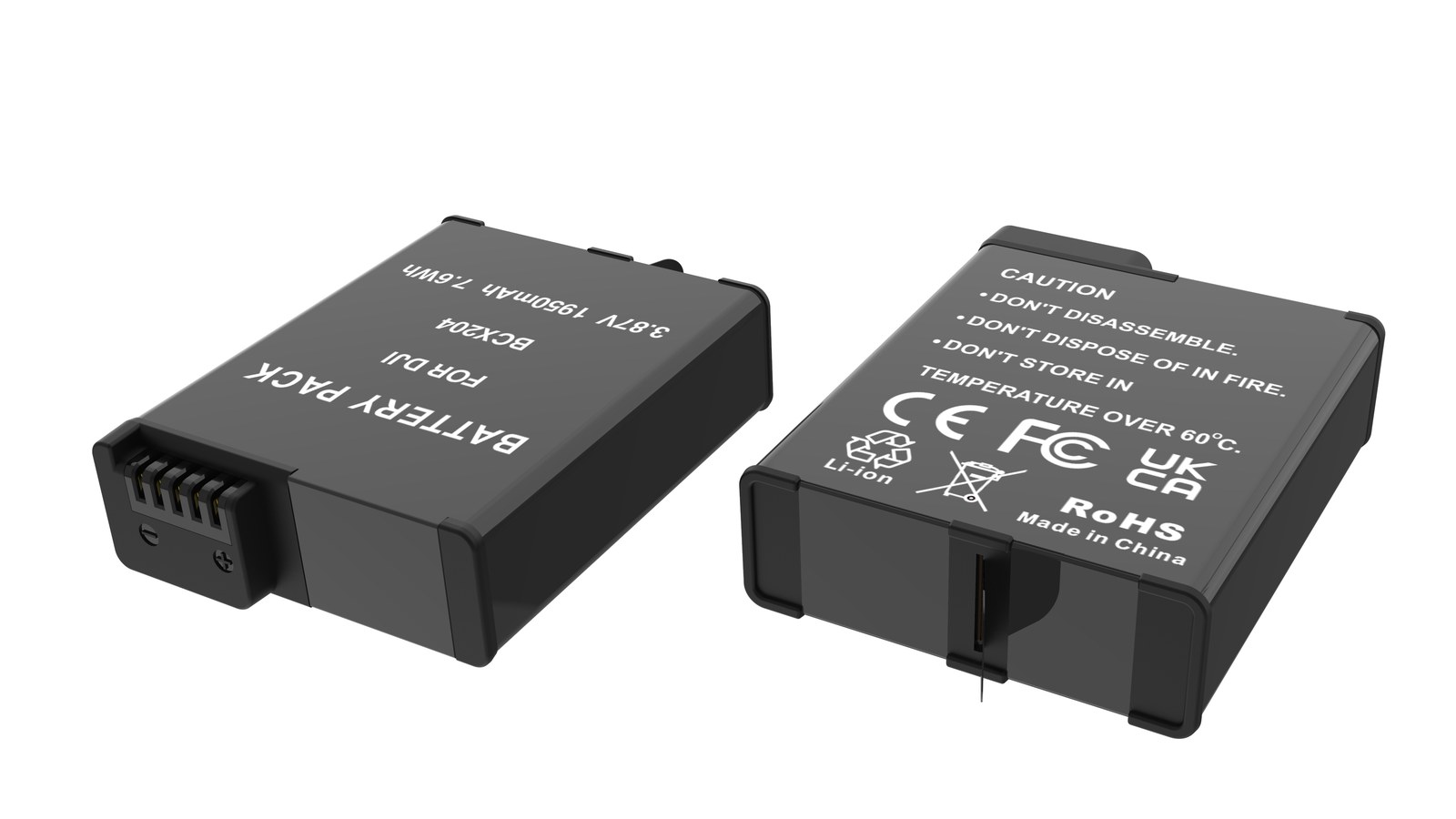
Short answer: a BCX204 can be charged three ways, and from fastest to slowest they are a multi-bay charging hub, a PD charger feeding the camera body, and an ordinary 5V charger feeding the body. The gap comes from how much power the body will accept, not from the figure printed on the charger. The pack is quoted at 1950mAh typical, 3.8V, 7.55Wh, with a rated figure of 1900mAh and 7.36Wh. That is not much energy, so any route fills a battery by morning. What needs planning is the order for three packs.
Product render of the YO BCX204 compatible battery: front label, rear LED charge indicator and USB-C port.
Where each route tops out
Charging through the body’s USB-C port is the least fuss. The cable and the charging circuit both sit inside the camera, and that circuit holds the current down to keep the body cool. In most cases the body draws at 5V, so input lands around 5W. If you are recording at the same time, part of that budget goes to the recording rather than the battery.
A multi-bay hub moves the charging circuit outside the camera. Each bay is fed separately, typically at 5V and 2A, which is about 10W per bay. The value is not speed on one pack but that two or three fill at once.
A PD charger does not set the speed by itself. If the body only draws at 5V, a 65W charger still delivers about 5W. Higher voltage steps only help when the body supports them. Read the input specification in the manual before buying.
Working out the times
Every figure below is an estimate. The formula is 7.55Wh divided by input power divided by 0.8, where 0.8 stands for the combined efficiency of the charging circuit and the cable. Add ten to twenty minutes for temperature, cable quality and idle draw.
Body at 5V and 1A, so 5W: 7.55 ÷ 5 ÷ 0.8 is about 1.9 hours.
One hub bay at 5V and 2A, so 10W: 7.55 ÷ 10 ÷ 0.8 is about 0.94 hours, roughly 55 minutes.
An 18W PD charger into a body that accepts 10W: 7.55 ÷ 10 ÷ 0.8 is about 0.94 hours. If the body stays limited to 5W, you are back to 1.9 hours.
The third line is the one to remember: a bigger charger buys nothing unless the camera agrees to take more.
Method
Assumed input
Estimated full charge
Best for
Body USB-C
5V / 1A, 5W
About 1.9 hours
Hotel room, car, top-ups on the move
Multi-bay hub
5V / 2A per bay, 10W
About 55 minutes
Two or three packs overnight at home
PD charger into body
18W charger, body at 10W
About 55 minutes
One charger for camera and phone
PD charger, body limited
18W charger, body at 5W
About 1.9 hours
Bodies without higher voltage input
Planning the night before
Take three packs and a full day of shooting. At seven in the evening two packs go into the hub. One bay needs about 55 minutes, two bays in parallel take about an hour, so both are full by a quarter past eight. The third pack goes in next and is done by a quarter past nine.
With body charging only, the schedule is tighter. One pack takes 1.9 hours, so three take close to six. Starting at seven means the first is done at nine, the second at eleven, and the third at one in the morning.
Charge the pack that goes into the camera first, before the spares. If the evening runs short, the camera still holds a full battery.
If you travel with a single PD charger, pick one with two USB-C ports, one for the camera and one for the phone. With both in use the power is shared and charging slows.
Using a camera battery as a power bank requires the body to support power output, and that is a question for the camera manual. On most action cameras the USB-C port is an input, used for charging and for powered recording, and reverse output is not part of the normal feature set.
If a phone needs a top-up, carry a small power bank instead. At 7.55Wh the BCX204 cannot fill a current phone once.
FAQ
Can a charging hub fill three packs at once?
It depends on the hub. Multi-bay hubs usually feed each bay separately, and parallel charging comes down to total output. When that is too low the bays take turns, generally left to right. Work from the total in the manual.
Does a phone fast charger damage the camera?
No. A fast charger negotiates a voltage step with the body first and falls back to 5V if no agreement is reached. The risk comes from cheap chargers with no protocol and unstable output.
Can I unplug halfway and finish the next day?
Yes. Lithium packs have no memory effect, and shallow cycles are gentler than deep ones. What matters is not leaving a pack flat for months. Charge it to roughly half before storing it.
Does recording while charging slow the charge?
Yes. The body has to feed the recording and the battery at the same time, so part of the input goes elsewhere and a full charge takes longer. The body also runs hotter throughout.
Short answer first: the “not genuine” style warning you get with a third-party NP-FZ100 is normally just a disclosure about charge display accuracy. It does not affect power delivery and it does not affect shooting, so you can carry on using the pack. Some Sony bodies phrase it as “the remaining charge may not be displayed accurately”. What it really means is that the body cannot fully confirm the discharge curve of a non-original pack, so it will not vouch for the percentage. The wording that should worry you is different: “cannot recognise this battery” or “this battery cannot be used”. That means the body is refusing to draw power, and it goes down the fault-finding path instead.
Product render of the YO NP-FZ100 compatible battery: front label, rear LED charge indicator and USB-C port.
What Each Message Actually Means
Body message
Nature
Can you keep shooting?
What to do
Remaining charge may not be displayed accurately
Standard disclosure
Yes
Nothing. Swap at one bar instead of waiting for empty
Not genuine / non-original battery notice
Identified as third-party
Usually yes
Confirm the spec matches, then carry on
Cannot recognise this battery / use a compatible battery
The test that matters is simple: can you shoot? If the camera powers on, fires and plays back, the message is informational. If it will not run at all, that is a fault, not a disclaimer.
Why the Warning Appears at All
Modern camera batteries carry a communication chip. The body reads data off that chip to estimate the remaining percentage. An original pack has a cell curve and internal-resistance profile that is fully modelled in the body firmware, so the readout tracks well. A third-party pack can match the spec sheet and still discharge slightly differently. With no matching curve in firmware, the body takes the conservative route and tells you the number may be off.
The important distinction: this is a communication and identification difference, not a power delivery difference. Whether a pack can drive the body depends on voltage, capacity and discharge capability, not on whether the firmware recognises the chip. The chip exists to report data back to the body; it does not gate how much current the pack can deliver.
Three Practical Effects on Shooting
Runtime is unaffected: real shot count comes from capacity and body power draw, not from the message. A pack rated around 2600mAh / 19.24Wh still delivers what its capacity allows.
The percentage may drift: slow to fall at the top, quick at the bottom, or a jump from two bars straight to shutdown. That is the inaccuracy being described.
A few functions may behave differently: a small number of bodies want extra battery data in certain modes. If something refuses to run, test once with an original pack to see whether the battery is the variable.
If the drift is obvious, one full charge-and-discharge cycle usually tightens it up. A full discharge followed by one uninterrupted charge usually pulls the readout back into line.
When the Warning Deserves Attention
Runtime is clearly shorter than a comparable pack — possibly overstated capacity or a worn cell.
Full-to-empty time swings wildly, or the body shuts down repeatedly mid-shoot.
The wording escalates from “may not display accurately” to “cannot recognise”, which points at contacts or model mismatch.
The pack is swollen, deformed, or hot to the touch while charging — stop using it.
You can sanity-check capacity with one full cycle and the body’s own shot count: if one pack is clearly behind another of the same rating, the cell is the likely cause.
Keeping Display Drift to a Minimum
Buy a spec-matched pack with a communication chip and clear capacity and voltage markings.
Run two or three full cycles on a new pack so the body can relearn the curve.
Store long-term at roughly 40–60% charge and top up every three months.
Keep terminals clean and dry. Oxidation raises the odds of flaky communication.
Rotate several packs instead of leaving one idle for months, which lets its curve drift.
FAQ
Can this warning damage the camera?
There is no evidence that the notice itself harms a body. What can cause harm is a poor cell with mismatched voltage or spec, which is why the buying decision should be based on spec, not on whether a warning shows up.
Can I turn the warning off?
Most bodies have no such option, and blocking it by unofficial means is not advisable. Treat it as a reminder that the percentage is indicative.
Does runtime get shorter once the warning appears?
No. Runtime follows capacity and power draw. A pack that feels shorter is usually worn or cold; the ageing curve is set out in capacity loss and replacement timing.
Do original packs never drift?
They generally track better, but an aged original jumps too. Around two years in, or after roughly 300–500 cycles, any pack can start misreporting.
Two charging options, same capacity: standard 2600mAh (dock required) or USB-C 2600mAh (phone charger or power bank). Pick the version on the NP-FZ100 product page; bulk pricing via wholesale.
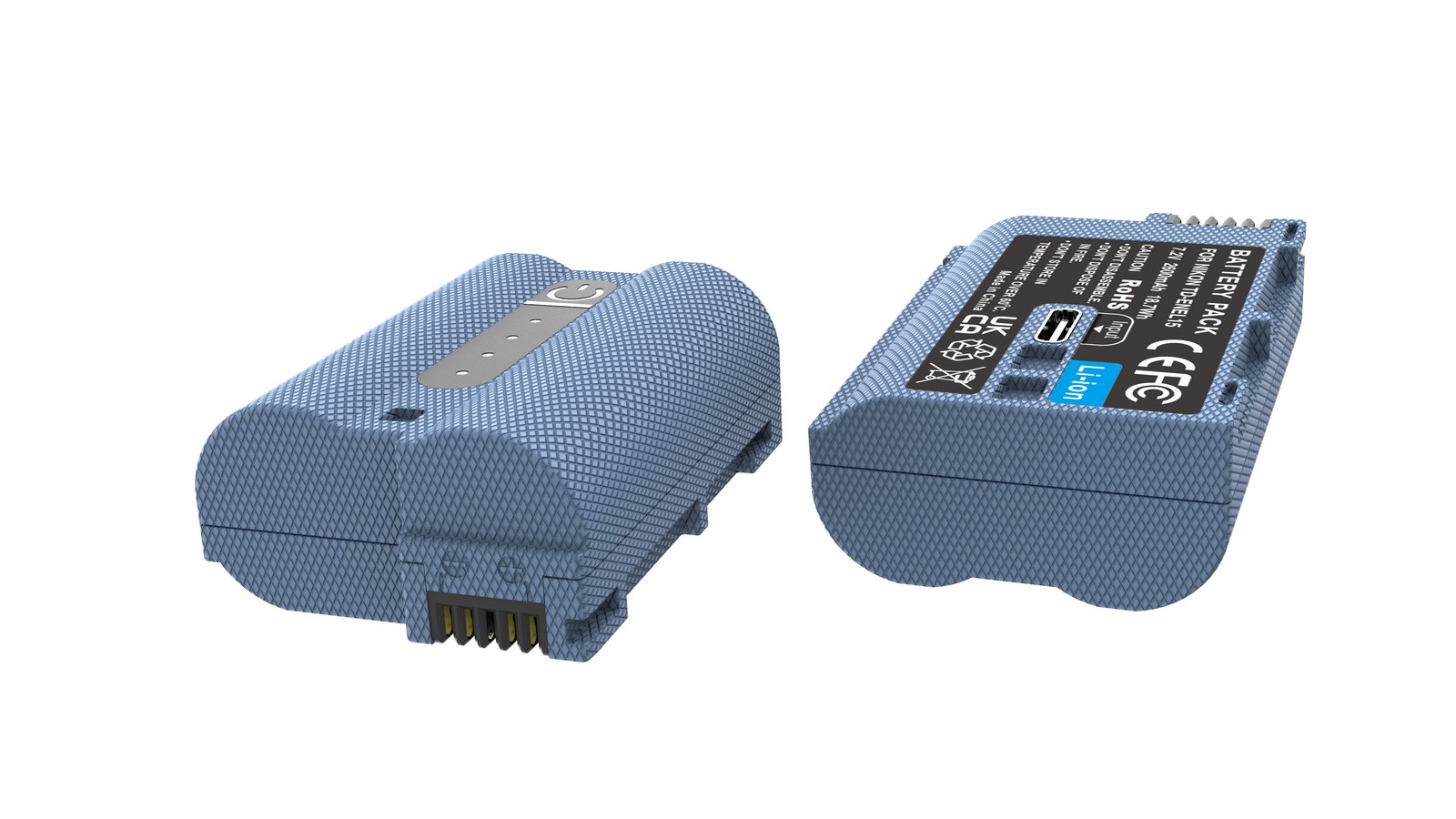
Short answer: the EN-EL15, EN-EL15a, EN-EL15b and EN-EL15c are all rated 7.0V, with identical external dimensions and terminal positions, so any body designed for the EN-EL15 family will accept any of them. The generational difference comes down to two things: capacity rising from 1900mAh to 2280mAh, and in-body USB charging arriving with the EN-EL15b. In other words, whether a pack fits is almost never the question; how much of the body’s capability it unlocks is. This article covers the specifications, the compatibility limits and what to buy.
Product render of the YO EN-EL15C compatible battery: front label, rear LED charge indicator and USB-C port.
The four generations compared
Nikon’s changes to this family have been gradual: the a version changed cell supplier without altering capacity, the b version added charge-management circuitry, and only the c version actually enlarged the cell. The figures below come from Nikon’s specifications and the pack markings, and are worth checking against a product listing.
Model
Nominal voltage
Capacity
Energy
In-body USB charging
Commonly supplied with
EN-EL15
7.0V
1900mAh
About 14Wh
No
D7000, D7100, D7200, D800, D600
EN-EL15a
7.0V
1900mAh
About 14Wh
No
D750, D500, D810, D850 (early)
EN-EL15b
7.0V
1900mAh
About 14Wh
Yes
D850 (later), D780, Z6, Z7
EN-EL15c
7.0V
2280mAh
About 16Wh
Yes
Z5, Z6 II, Z7 II, Z8, Z6 III
On paper the c version holds about 380mAh more than the first generation, roughly 20%. In real use that corresponds to a hundred or two hundred extra frames, or a dozen-odd extra minutes of 4K — enough to notice, and nowhere near the doubling that marketing language sometimes implies.
Note that the a version and the original are identical in capacity; only the cell batch and supplier differ. So if you see a second-hand listing claiming the EN-EL15a holds more, that is not accurate — what changed was the production year, not the charge.
Backward compatibility: fitting is not the same as working
Nikon’s logic is that new packs work downward and old packs work upward with caveats. There are three layers.
The first is physical. All four generations share the same length, width, height, terminal positions and latch shape, so a D7000 will take an EN-EL15c and a Z8 will take a first-generation EN-EL15. There is almost no exception here, and a third-party pack with a correct mould will insert just as readily.
The second is electrical. When an older body cannot identify a newer pack’s communication chip, the usual outcome is not a refusal but an inaccurate gauge: it may fall bar by bar, or suddenly drop from two bars to shutdown protection. On early-2010s bodies such as the D7000 and D7100, jumping charge levels with a c-version pack are a common sight.
The third is functional, and it is the most overlooked. In-body USB charging and USB PD shooting require the pack to carry charge-management circuitry, which only the EN-EL15b and EN-EL15c have. Fit a first-generation EN-EL15 to a Z6 or Z8 and the camera still shoots, but plugging in a USB-C supply will not charge the pack.
Matching a pack to the body
There is no need to default to “newest is best”. Three tiers by body generation is more practical:
D7000 / D7100 / D7200 / D600 / D800 series: an EN-EL15 or EN-EL15a is enough. These bodies do not support in-body charging in the first place, so paying more for a c version unlocks no function — only about 20% more capacity.
D750 / D500 / D810 / D850 / D780: favour the EN-EL15b or c. The D780 and later D850 batches support USB charging, and only the b version upward can use it.
Z5 / Z6 series / Z7 series / Z8: go straight to the EN-EL15c. This generation keeps the finder lit and stabilisation running, so the draw is nothing like a DSLR, and a 20% capacity difference shows clearly in practice.
If you own both a DSLR and a mirrorless body, standardising on the EN-EL15c is simplest: in the old body the only downside is a possibly inaccurate gauge, which does not affect shooting, while in the new body it is fully featured. Standardising on the first generation, by contrast, means giving up USB charging in the new body.
The “battery cannot be used” message with third-party packs
Newer bodies such as the Z8 and Z6 III validate battery communication more strictly, and some third-party EN-EL15c packs trigger a “this battery cannot be used” message or refuse to enter certain heavy-load modes. The cause is usually not an inflated capacity but a communication protocol that is not fully aligned.
Check two things when buying: whether the marking states 7.0V / 2280mAh explicitly rather than vaguely saying “EN-EL15 compatible”, and whether the maker has published adaptation notes for the Z8 and Z6 III. Manufacturers that build to a single model, such as YO, usually list the bodies they have tested on the product page, which is more credible than a blanket “fully compatible” claim.
One more tip: the genuine MH-25 series dock charger is strict about third-party packs and will occasionally stop partway through. When that happens, a third-party charger with wider voltage recognition is often a more effective fix than a new pack.
If you also have a small mirrorless body such as the Z50 or Z fc that uses the EN-EL25, the two systems do not share chargers, so do not expect one dock to cover every body — see the Nikon EN-EL25 category. Users working across brands can compare the compatibility logic in the Canon LP-E6 series, and will find that the approach to new-packs-work-downward is broadly similar.
FAQ
Will an EN-EL15c work in a D7000?
It fits and it shoots. The D7000 does not support in-body USB charging, so the c version’s charge-management circuitry goes unused and all you gain is capacity. The gauge may jump, which is normal and does not affect image quality or the shutter.
What is the difference between the EN-EL15b and EN-EL15c?
Only capacity and the cell. Both support in-body USB charging and share the same electrical protocol. The b version is 1900mAh, the c version 2280mAh. If your body is a Z6 II, Z7 II or Z8, go straight to the c version.
Why doesn’t my Z8 charge over USB-C?
Confirm three things: that the pack is an EN-EL15b or c, that the supply supports USB PD at sufficient output, and that the cable is a data-capable C-to-C lead. If any one is missing, the body may simply hold the power supply without charging.
Can the four generations be mixed?
Yes, but not within one vertical grip. Two packs of different capacity and internal resistance discharge along different curves, and the body raises an early warning based on the weaker one. More on the EN-EL15 is in the Nikon EN-EL15 category.
The cheapest way to get more frames out of one NP-FZ100 isn’t another battery — it’s the settings menu. The ten changes below are ordered by gain versus cost. Applied together, they typically add roughly a third to a half more frames in mixed shooting. If you currently leave Wi-Fi on, compose on the screen and review constantly, the improvement is larger and can approach double. The NP-FZ100 is rated 2600mAh / 7.2V / roughly 19.24Wh and works across the A7 III, A7 IV, A7R V, A9 II, A6700, FX3 and more, so dialing these in is effectively free capacity on every pack you own.
Product render of the YO NP-FZ100 compatible battery: front label, rear LED charge indicator and USB-C port.
The ten settings and what they’re worth
Setting
Approx. gain
Effort
Cost to you
Airplane mode on
About 10–20%
Low
No remote, no instant transfer
Shorten auto power-off
About 5–15%
Low
More half-presses to wake
Viewfinder priority
About 10–20%
Low
Different shooting position
Lower screen brightness
About 5–10%
Low
Harder to see in bright light
Turn off auto review
About 5–15%
Low
No instant confirmation
Disable stabilization when unused
About 5–10%
Medium
Lower safe shutter speed handheld
Switch to single AF
About 5–10%
Medium
Fewer keepers on action
Drop phone link and location logging
About 5–10%
Low
No geotagged files
Simplify display overlays
About 3–8%
Low
Less info on screen
Temperature management
About 20–50% in cold
Low
Carry more, keep them warm
These are experience-based ranges that shift with body, firmware and the rest of your setup. Use them to set priorities, not as measured results.
First five: small changes, real gains
1. Airplane mode, killing Wi-Fi, Bluetooth and NFC
Radios are the invisible drain. Wi-Fi sitting in wait of a connection and Bluetooth shaking hands with your phone draw power even when nothing is being transferred. When you don’t need transfer, flip on airplane mode or switch the radios off individually, then turn them on only while sending. This is the most reliable item on the list.
2. Set auto power-off to the shortest option
A camera idling between frames burns through measurable charge in just a few minutes. Set the auto power-off start time to one minute — some bodies offer 30 seconds — and get used to waking it with a half-press. Over a day it adds up.
3. Viewfinder priority, not a screen that’s always on
The viewfinder is a tiny panel; the rear screen is around three inches with a backlight. Set the finder/monitor selection to viewfinder priority and kill any behavior that leaves the screen lit between shots — viewfinder versus screen draw covers the detail.
4. Brightness only as high as you need
Dropping from maximum to a middle setting doesn’t save much on its own, but paired with viewfinder use it compounds. In bright outdoor light, raising brightness is the wrong move anyway — the finder is both cheaper and easier to read.
5. Turn auto review off or down to one second
Two seconds of screen per frame means hundreds of screen wake-ups per day. Review in batches during lulls instead of checking every shot.
Middle three: some trade-offs
6. Stabilization off on a tripod or at high shutter speeds
In-body and lens stabilization draw current while they work. Turn them off when the camera is on a tripod or when fast shutter speeds are freezing the action; keep them on for handheld low light, where sharpness matters more. They’re separate systems and some bodies let you control each one.
7. Single AF instead of continuous
AF-C keeps the focus motor and processor computing nonstop. For static subjects, AF-S or manual focus is cheaper. Sports and kids are the exception — don’t economize there.
8. Break the phone link and location logging
Pulling location from a phone keeps Bluetooth alive in the background, which is a hidden cost. Switch off location logging when you don’t need it and disconnect the standing phone link.
Last two: the ones people skip
9. Trim what’s on the displays
Always-on histograms, grids, levels and focus peaking add processing load. Turn off what you don’t need and call it up when you do. Day to day you won’t notice.
10. Temperature: the underestimated one
Below freezing, capacity drops sharply and around -10°C you may see roughly half of normal. No setting fixes that. In winter, spare packs in an inside pocket and regular rotation beat all ten menu items combined — more in battery behavior in cold weather.
One more: HDMI out and wireless remote
An external monitor connected, or a wireless remote receiver listening, keeps the body outputting or polling. Disconnect when you’re not using them. Accessory draw often outweighs the menu items above.
FAQ
Will these really double my frames per pack?
Depends where you start. Coming from Wi-Fi on, screen composing and constant review, the gain can approach double. If your setup was already lean, expect closer to a third.
Do power settings hurt image quality?
No. These change radios, displays, focus behavior and stabilization — not exposure or imaging. The one indirect effect is that disabling stabilization can affect handheld steadiness.
Do they help during video?
They help less. Sensor and processor dominate while recording; killing radios and dimming the screen still saves something, but less than in stills. For long takes, look at dummy battery and power adapter options.
Should I buy fewer batteries once I’ve done this?
Do the settings first, then decide the count. Settings are free; extra packs add weight, storage and rotation overhead.
Only need a spare? The NP-FZ100 2600mAh comes on its own, with a charger, or as a two-battery kit. Both versions hold 2600mAh; the USB-C one costs slightly more and saves you carrying a dock.
On a long landscape trip, temperature is the real problem. The NP-FZ100 is rated 2600mAh / 7.2V / around 19.24Wh, and at room temperature official CIPA figures generally sit in the 500–700 frame range. Drop below 0℃ / 32℉ and capacity falls noticeably; around -10℃ / 14℉ you may see roughly half of normal. So on high plateaus, snowfields and shoulder-season routes with big day-night swings, do not plan from warm-weather experience.
Product render of the YO NP-FZ100 compatible battery: front label, rear LED charge indicator and USB-C port.
Three things do the work: keep spare cells warm against your body, carry more of them and rotate by number, and charge whenever the vehicle or a hotel is available. Altitude itself has limited direct effect on lithium cells. The variables that bite are cold, extra heat loss from wind, and how rarely you get a socket.
Why cold drains an NP-FZ100 faster
A lithium cell discharges through internal chemistry. As temperature drops, the electrolyte thickens and lithium ions move more slowly, so internal resistance rises. Usable capacity shrinks, and under heavy current — burst shooting, IBIS, video — voltage sags further, so the body calls it empty sooner.
Around 0℃ / 32℉: capacity starts to drop clearly; figure on losing roughly 10%–20% of normal runtime.
Near -10℃ / 14℉: possibly about half of room-temperature capacity, and slow to recover while it stays cold.
Back at room temperature: capacity usually returns. This is a reversible performance drop, not a dead cell.
The irreversible part: forcing high current out of a frozen cell, or charging it while cold, can add permanent wear.
What makes high-altitude routes different
Air pressure change on its own barely touches a battery. It is the combination that makes mountain trips hard:
Big day-night swings: the camera bakes in a bag by day and sits below freezing at night, so cells take repeated thermal shocks.
Few charging chances: multi-day treks and remote routes can go several days without mains power, leaving vehicle or solar as the only options.
Strong sun, thin air: bodies shed heat poorly, so long live-view and video work triggers overheat warnings sooner.
Long waits: landscape work is mostly waiting for light, and idle draw becomes a bigger share of the day.
Build in more margin than a normal day. A common rule of thumb is 30%–50% more cells than your room-temperature estimate.
The two fixes that actually work
Keep them warm against your body
Carry spares in an inside jacket pocket or against your base layer, where body heat holds them near room temperature. Put a cell into the body only when you are ready to shoot. That beats leaving them in a side pocket of the camera bag — and never leave spares on a car window ledge, at a tent door or clipped to the outside of a pack.
Rotate in small batches
Do not let one cell sit in the body taking wind until it is empty. Swap it out at around 30%–50% and put it back inside your jacket; drop in another warm one. A warmed-up cell often gives up more capacity on the second pass, which is a trick landscape shooters have used for years.
Keep the camera warm too
Use a body sleeve or a simple insulating cover to slow internal cooling.
Power down during long waits instead of leaving the camera idling, and stow it in the bag.
Do not power a freezing camera on the moment you step into a warm room. Let it warm up inside the closed bag first, so condensation does not form on the electronics.
Run a dual charger in the car; top up on every transfer
Long route with lodging
Mains each night
Dual or four-slot charger; shoot by day, refill overnight
Multi-day trek
None
Large power bank with a USB charger, or carry enough cells per day
Fixed-position timelapse
Depends
Dummy battery on a power bank, wrapped against the cold
How to layer cells in a bag and how to handle airports is covered in battery packing for travel shooting. At around 16.4Wh the NP-FZ100 is well under the 100Wh limit, spares go in carry-on only, and terminals need short-circuit protection.
Power-saving settings for cold days
Shortest auto power-off: shut down while waiting for light rather than idling.
Lower screen brightness: in cold air your eyes adapt, so mid-level is normally plenty.
Wi-Fi and Bluetooth off: background links just add draw.
Review less: working a screen with cold fingers is its own penalty.
Go easy on long live-view sessions: frame up, then switch back to the EVF.
Better not below 0℃ / 32℉. Charging a cold cell can plate lithium and cause permanent damage. Bring it back to room temperature first — a simple habit that protects the cell’s life.
Do cells swell at altitude?
Low pressure is not a direct cause, though the pressure difference across the shell does change. If a shell looks swollen, the contacts look wrong or it smells off, stop using it and send it to a recycling point. Do not keep charging it.
Runtime came back at lower elevation. Do I still need new cells?
Usually it is fine to keep using them. If a cell still underperforms its siblings once it is warm again, it has likely seen a lot of cycles and can be rotated out.
Do high-resolution bodies like the A7R IV or A7R V use more power up high?
They do. More pixels means more data to process, and live view and burst work cost more. Combined with cold, the drop feels bigger, so carry extra margin.
Two charging options, same capacity: standard 2600mAh (dock required) or USB-C 2600mAh (phone charger or power bank). Pick the version on the NP-FZ100 product page; bulk pricing via wholesale.
Short answer: the first rule for buying video batteries is to follow the body, not the spec sheet. If your body ships with an LP-E6NH (R5, R6, R6 II, R7), the LP-E6NH is the sensible buy; only a body supplied with an LP-E6P (R5 Mark II, R1) needs one. Fit an LP-E6P to an older body and it will usually run as an ordinary LP-E6-class pack — the extra money buys no extra capability.
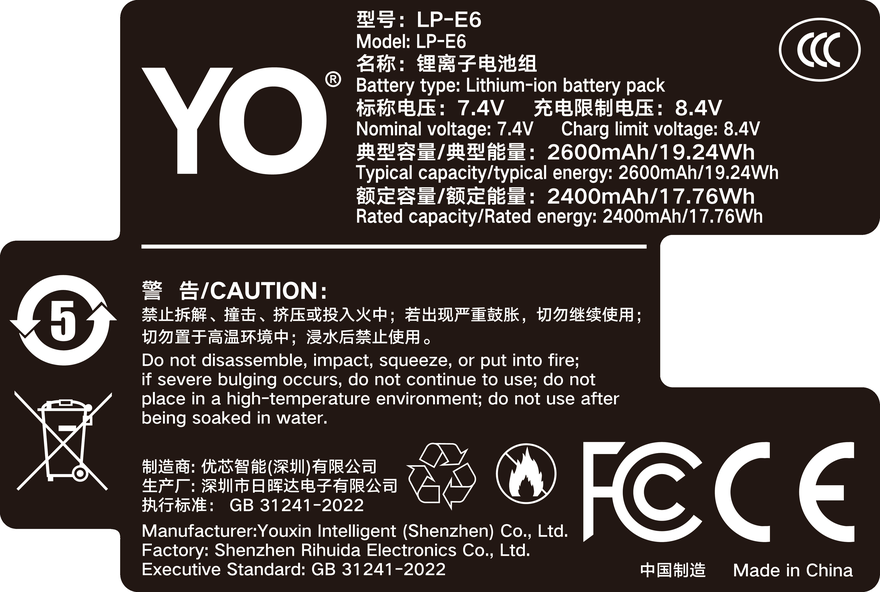
Rating label of the YO LP-E6NH battery: nominal voltage, typical capacity and safety certifications.
The conclusion sounds unremarkable, but it is exactly where purchases go wrong. The LP-E6P is the newest generation in the family and looks “stronger” on paper, so the instinct is to buy new rather than old. The catch is that a pack’s capability is a ceiling, and whether the body can use that ceiling is a separate question — settled by the power circuit and firmware, not by the pack itself.
1. Separate pack capability from body demand
The LP-E6NH is a capacity-oriented 2130mAh / 7.2V pack sized for the power draw of the R5, R6, R6 II and R7 generation. The LP-E6P arrived in 2024 with the EOS R5 Mark II, and Canon emphasizes higher continuous discharge rather than more capacity — it stays in the 2130mAh class. In other words, the difference is how much current it can sustain, not how much energy it holds.
Continuous discharge only matters when the body actually asks for it. The R5 Mark II places higher demands on momentary and sustained current in 8K, RAW video and high-frame-rate modes, and the LP-E6P exists so those modes run to completion. The R5 and R6 II were designed around the LP-E6NH’s capability envelope, so a pack with more discharge headroom does not unlock new specifications.
2. Body by body
Body
Supplied pack
LP-E6NH fitted
LP-E6P fitted
EOS R5 / R6 / R6 II
LP-E6NH
Native, full function
Fits; usually runs at the ordinary level
EOS R7
LP-E6NH
Native, full function
Fits; usually no added benefit
EOS R5 Mark II
LP-E6P
Fits; high-load modes may be limited
Native, full capability
EOS R1
LP-E6P
Fits; high-load modes may be limited
Native, full capability
5D Mark IV / 6D Mark II / 90D
LP-E6N
Compatible, not the supplied pack
Compatible, usually at LP-E6 level
The row worth studying is the last one. The 5D Mark IV, 6D Mark II and 90D shipped with the LP-E6N (1865mAh), so an LP-E6NH is a working compatible pack rather than the original. All four generations share the same shape and interchange physically, but firmware recognizes generations differently, and the relationship between the gauge and actual capacity may not line up exactly.
3. Three extra considerations for video
First is thermal pacing, not raw capacity. During a continuous take the pack warms up and the air inside the body warms with it. Internal resistance rises with heat, terminal voltage sags more readily, and that trips protection or ends the take earlier than “a few hundred milliamp-hours less” would suggest. For video, the number of packs matters more than the size of any one, because it lets packs rotate and cool.
Second is charger reuse. The LP-E6NH and LP-E6P both run on the LC-E6 / LC-E6E dock family, so one charger covers both. That is the benefit of a shared form factor — if your kit includes both generations, you need one set of chargers and enough outlets.
Third is whether external power is viable. Some bodies accept USB-C PD input, which lets you run from mains on a locked-off shot and save packs for handheld work. Whether that path works on your body, and at what wattage, depends on the specific model — check the manual rather than assuming it applies across the range.
4. When the premium makes sense, price brackets and buying pace
There is one reasonable case: you own an R5 Mark II or R1 and want a single set of packs to serve both, reducing what you carry. Buying LP-E6P then is paying for commonality, not upgrading an older body. Be clear that in an older body it usually works at the ordinary LP-E6 level — the premium buys cross-body flexibility.
The reverse case is more common and more worth flagging: fitting an LP-E6NH to an R5 Mark II. It will not damage anything, but in 8K or RAW modes the body’s demand exceeds the pack’s sustained output, and you may see limited recording time, unexpected stops, or a message that a function is unavailable. The exact limits depend on the body documentation and firmware version.
On price, Canon packs typically sit in the several-hundred-yuan bracket and vary by channel, so no exact figure is given here. Compatible packs cost clearly less, often by enough to buy one or two more. For video the sensible approach is not “buy fewer, all Canon” but “Canon for the primary, compatible for the rest” — one Canon pack covers the critical take, two or three compatible packs cover long days, and total cost comes out lower. YO’s LP-E6NH-compatible pack is designed for exactly that backup role.
On buying pace, follow the body: when a new camera arrives, start with the supplied pack plus two compatible ones, then decide on more after one full project tells you your real power curve. Buying five at once usually leaves half of them aging in a drawer. More on compatibility is in the LP-E6NH category and the LP-E6P category. If you see products labeled LP-E6+ on the market, bear in mind that LP-E6+ is not a Canon designation — it is how some third parties label an enhanced version, so judge by cell specification and protection-board design, and compare against the LP-E6+ notes and the LP-E6 category.
FAQ
Will an R6 II last longer with an LP-E6P?
Usually not noticeably. The two are in the same capacity class and the difference is sustained current, which the R6 II’s power design does not need extra headroom for. Real runtime differences come more from pack age and shooting temperature than from generation.
Can an LP-E6P damage an older body?
Not in normal use. The voltage platform matches and the body has its own protection logic. The real risk is packs of unknown origin without a protection board — a quality issue unrelated to generation.
How many packs does a video shooter actually need?
For projects built around long 4K takes, two to start and three to be comfortable. For 8K or high frame rate, take the worst-case single-take duration, multiply by the number of takes, and add one spare. The real duration has to come from a baseline test on your own body.
Can I carry LP-E6NH and LP-E6P together?
Yes — the shared shape exists for exactly that. Two cautions: try to use one generation within a single shoot so remaining-time estimates stay meaningful, and do not move packs between bodies day to day without notes, or you will not be able to tell degradation from a change in how you shoot.
Short answer: with the same 950mAh LP-E17, usable time on an 850D is usually one to two tenths shorter than on a 200D II, but the framing method opens a much bigger gap than the body does. One point needs clearing up first: the EOS 200D II and the EOS 850D are both DSLRs, so this is not a DSLR-versus-mirrorless comparison. They share a battery and a generation of image processor; the differences lie in positioning and feature set.
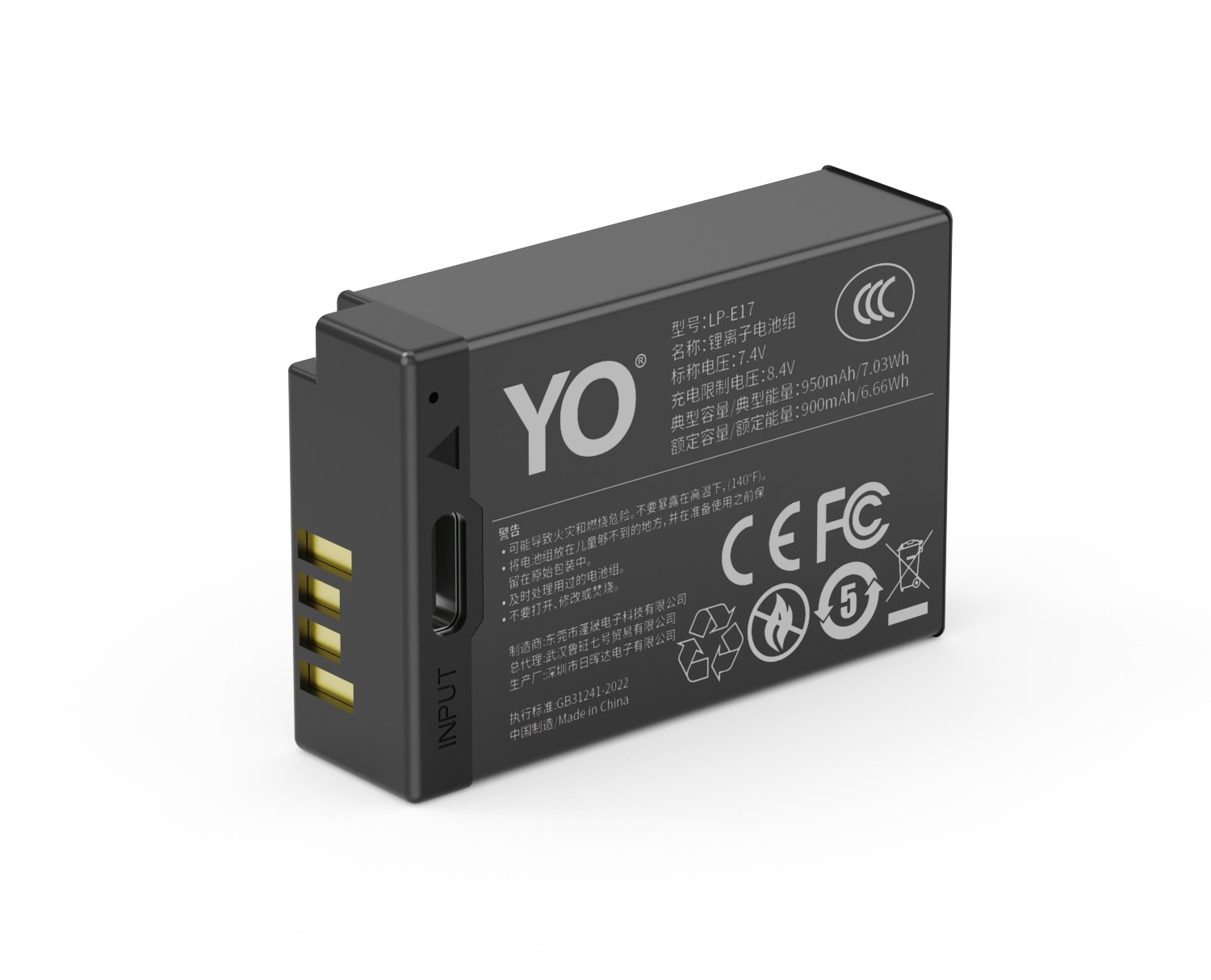
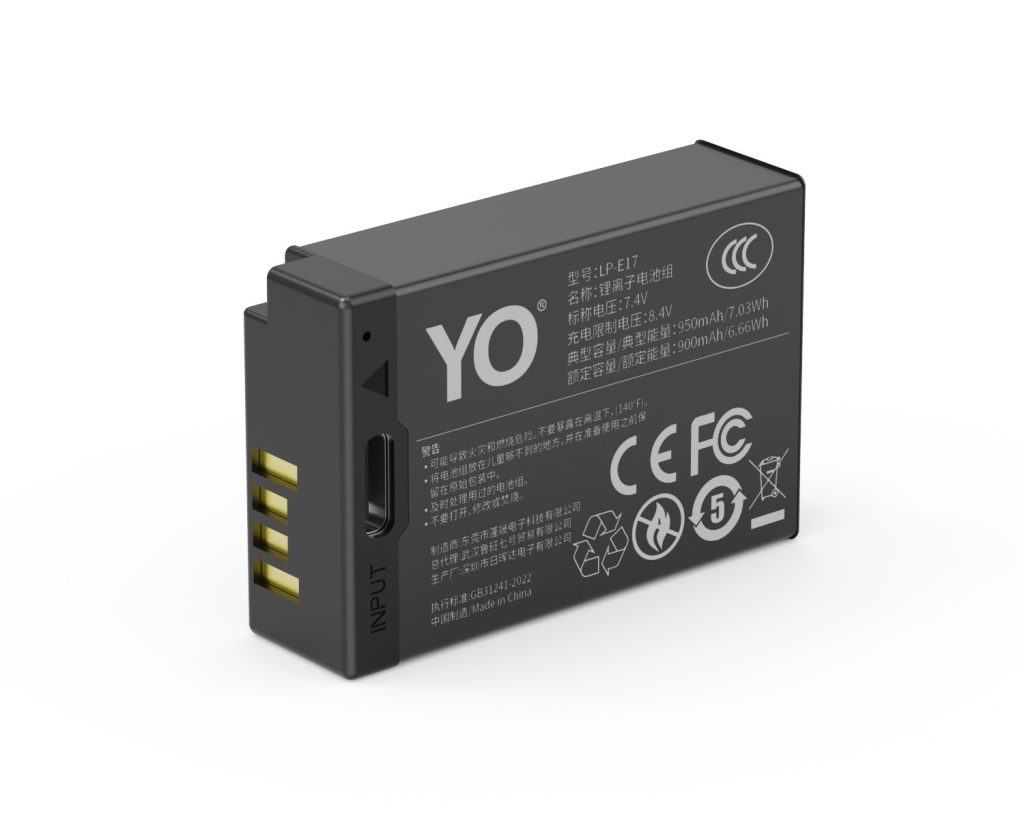
Product render of the YO LP-E17 compatible battery: front label, rear LED charge indicator and USB-C port.
That premise matters, because a lot of runtime discussion treats “DSLRs are frugal” as a finding, when in fact the frugality depends on using the optical finder. Switch to live view on the screen and a DSLR’s power profile is not fundamentally different from a mirrorless body’s.
Both are DSLRs; the difference is positioning
The 200D II is an entry-level lightweight body built around small size and low weight, with a fairly basic 9-point autofocus system, moderate burst speed and a compact grip. The 850D sits half a step up, with 45 all-cross-type points, faster bursts, a larger and brighter finder, and a chunkier body.
Every one of those upgrades turns into current draw. More focus points mean heavier metering and focus computation; a faster burst means the shutter and mirror move more often; a larger finder costs nothing optically, but the overlaid information display adds a little. Each item is small on its own, and together they account for the one-to-two-tenths gap.
It is worth stressing that this is not a case of the 850D being worse because it draws more. It is the normal price of performance. People buying an 850D need the stronger autofocus and burst rate, and a slightly shorter runtime is within expectation.
Framing method is the real divide
The reason a DSLR gives the impression of running forever on one battery is that with optical framing the sensor is idle and the screen is dark. The draw then comes mainly from metering, the focus module and a small amount of circuitry, which is a very low order of magnitude. A 950mAh lasts longer in this mode than most people expect.
Open live view, however, for video, low-angle framing or a selfie on the articulating screen, and the sensor goes into continuous readout while the screen also draws. The consumption curve steps up immediately. At that point the gap between the 200D II and the 850D widens, because their load profile now looks much more like a mirrorless body’s.
How you shoot
200D II relative draw
850D relative draw
Optical finder, single frames
Low
Low, slightly above the 200D II
Live view on screen, stills
Medium
Medium to high
Burst shooting (high speed)
Medium
High
4K clip recording
High
High, with noticeable heat
Cold outdoor work
Usable capacity shrinks
Usable capacity shrinks, more visibly
This table gives relative magnitudes, not absolute times. On the same body, taking screen brightness from minimum to maximum, or leaving Wi-Fi on, can change the result as much as switching bodies. Fix the conditions before comparing, or the comparison means nothing.
What 950mAh is worth on these two bodies
The 950mAh is the middle tier of the three, about 27% more than the 750mAh and about a tenth less than the 1050mAh. On a 200D II it is in the range of one battery covering most of a day of stills. On an 850D the difference is small if you mostly use the optical finder, but if you lean on live view or bursts, the odds of a mid-session swap rise noticeably.
A practical way to judge is your framing ratio. If more than eight tenths of your time is optical, the 950mAh is enough even on the 850D. If eight tenths of your time is spent looking at the screen, size your batteries by mirrorless standards: carry an extra one, or move up in capacity.
Cold matters too. Outdoors in winter both bodies lose usable capacity, and because the 850D draws more to begin with, the remaining margin is tighter. Keeping spares in an inside pocket is more effective than buying more capacity.
Mirrorless needs a different calculation
If what you really want to compare is DSLR versus mirrorless efficiency, then pit a 200D II against an LP-E17 mirrorless body such as the M6 Mark II or the R50. The conclusion is fairly clear: a DSLR used mainly with the optical finder is more frugal for stills, while an electronic-viewfinder body gets less runtime from the same capacity, often by more than two tenths.
The reason is straightforward. A mirrorless body frames from the moment it is switched on, with sensor and finder running throughout, which is a constant overhead; a DSLR only enters a high-load state when you press the shutter or enable live view. So “the 950mAh lasts on a DSLR and is average on a mirrorless body” is not a battery problem, it is a difference in how the body works.
For capacity recommendations by body, see the tiering advice in the capacity and compatibility guide. If a mirrorless body will be your primary, the 1050mAh tier is more comfortable, while the 750mAh suits DSLR users better as a light top-up.
FAQ
Do the 200D II and 850D use the same battery?
Yes. Both take the LP-E17 and both charge on the LC-E17, so batteries are interchangeable. That is why many two-body users mix them; just label each battery.
Why does my 850D drain so much faster than a friend’s 200D II?
Check first whether you are shooting the same way. If they mostly use the optical finder for single frames while you use live view or bursts heavily, the gap can double, which is beyond the difference between the bodies. Then check battery condition and temperature, because old batteries perform noticeably worse in the cold.
How long will a 950mAh last on an 850D?
There is no single figure. A fair statement is that with optical framing it covers roughly half a day to a full day of stills, and with live view or video it usually needs a second battery. Build a baseline on your own body under fixed conditions rather than borrowing someone else’s number.
Are DSLRs always more frugal than mirrorless bodies?
Only with optical framing. Once live view is on, a DSLR’s sensor runs continuously too, and its power profile approaches a mirrorless body’s. So the accurate version of “DSLRs are frugal” is “optical framing is frugal”.
Compare watt-hours before milliamp-hours: our NP-F960 compatible cell is 5400mAh / 38.9Wh, with the original NP-F970 setting the baseline. Milliamp-hours describe charge, not energy, so they cannot be compared across voltage platforms. Watt-hours (voltage x capacity) are the honest figure. Where a label states both a typical and a minimum rating, use the minimum for conservative runtime estimates.
Key specifications and limits: 5 W 7 h / 15 W 2.5 h / 38.9 Wh. Actual figures vary with resolution, frame rate, screen brightness and ambient temperature, so plan spares around the shortest figure in the table.
Original vs our cell, item by item
The table puts the original rating and our compatible cell on the same basis. Price is the listed retail figure; check the product page for current terms. Where a minimum rating is printed, that figure is the better basis for conservative estimates.
Item
Original
Our compatible cell
NP-F960
—
5400 mAh
Wh
—
38.9 Wh
mAh (min)
—
—
CNY
—
¥212.4
Balancing capacity, price and warranty
Higher capacity does not double your shots: the body cutoff voltage and its fuel-gauge algorithm both shape the reading. For a spare cell, price, cycle life and warranty often matter more than the peak number.
Item
Value
NP-F960
NP-F550 / F750 / F960 / F970
NP-F970
Sony NP-F960
np-f960
5400 mAh / 38.9 Wh
NP-F960
5 W 7 h / 15 W 2.5 h / 38.9 Wh
α7 / α9 → NP-FZ100 / F750
NP-F550 / F750 / F960 / F970
NP-F550 / F750 / F960 / F970
5400 mAh / 38.9 Wh
Choosing a kit by shooting load
For light use, one original plus one spare is enough. For a full day of travel or video work, carry two or more and rotate them through a dual-bay charger.
To pick by model, start with the specifications and stock status on Sony NP-F960 5400mAh, then browse the full article set in NP-F960; if your body belongs to a neighbouring system, NP-BX1 has the side-by-side explanation.
FAQ
Is 5400mAh an inflated rating?
Our NP-F960 compatible cell is specified at 5400mAh / 38.9Wh. with the original NP-F970 setting the baseline. Compare the Wh figures rather than mAh alone.
Should I look at mAh or Wh?
Wh. Milliamp-hours only become energy once multiplied by voltage, so comparing mAh across different voltage platforms is misleading. 38.9Wh is the like-for-like baseline for this pack.
Can a higher-capacity cell damage the camera?
No. As long as the shell, contacts and protection circuit match the system, capacity only affects runtime. The one caveat is that older bodies may report charge level inaccurately.
Should I buy one cell or two?
For a full day outside or video work, carry two or more and rotate them through a dual dock. For indoor or short sessions, one original plus one spare is enough. Budget conservatively against the 5 W LED baseline.