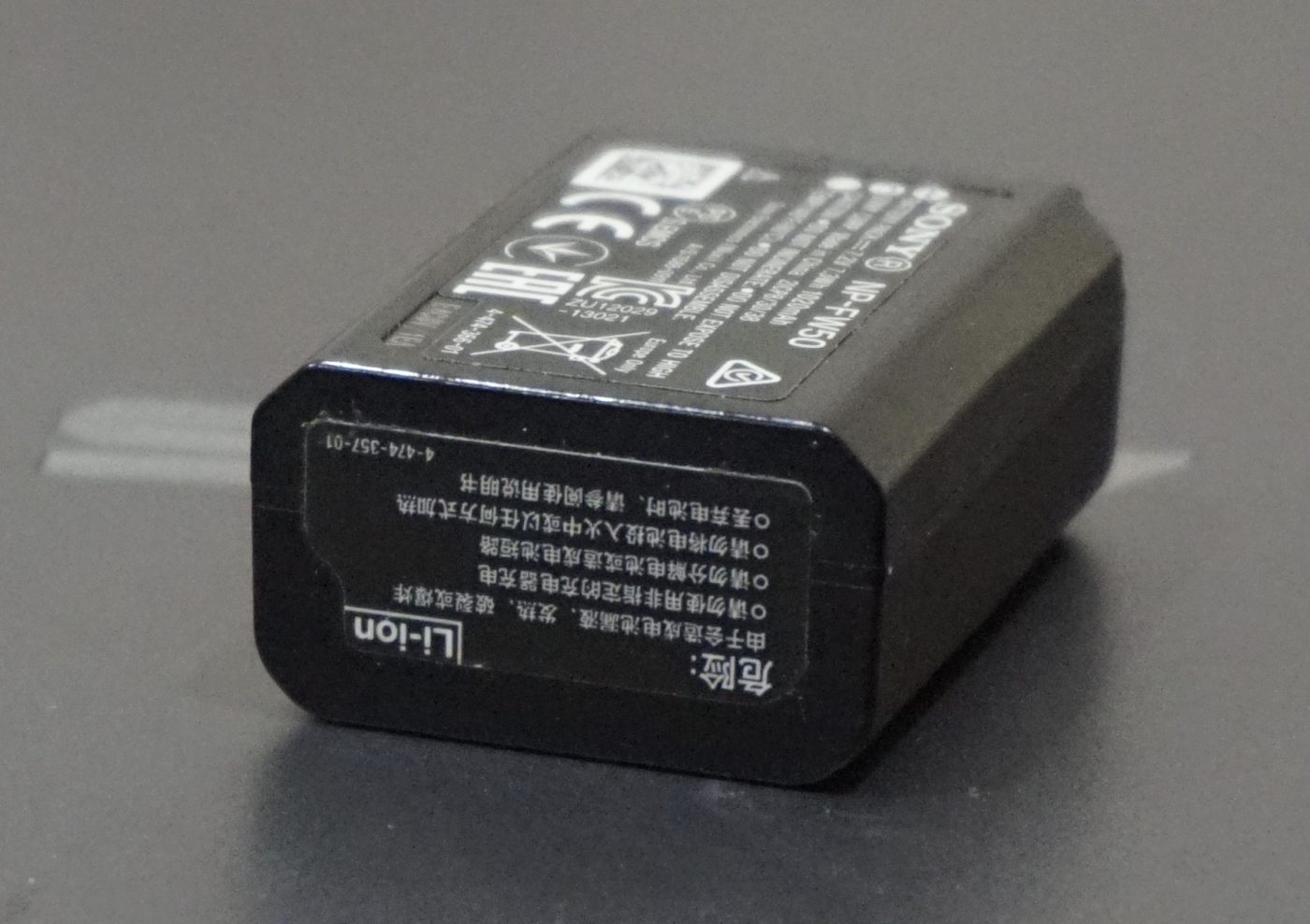
Short answer: six full-frame bodies sit on Sony’s official NP-FW50 list — the α7, α7R and α7S first generation, plus the α7 II, α7R II and α7S II. Third-party equipment references quote CIPA rated stills counts between roughly 290 and 370 frames under standardised test conditions, not field results. With an 8.14Wh cell the planning method is the same as for APS-C bodies: divide, round up, leave headroom. Watch the naming: the α7 II takes NP-FW50, while the α7 III moved to NP-FZ100 and will not fit.
The six full-frame bodies
The table follows the model codes used on Sony’s compatibility page. The CIPA column collates manufacturer ratings from third-party equipment references; we have not measured them and do not present them as real frame counts.
| Body | Code | On Sony’s NP-FW50 list | CIPA rated stills (not a field test) |
|---|---|---|---|
| α7 | ILCE-7 | Yes | Approx. 340 frames |
| α7R | ILCE-7R | Yes | Approx. 340 frames |
| α7S | ILCE-7S | Yes | Approx. 370 frames |
| α7 II | ILCE-7M2 | Yes | Approx. 350 frames |
| α7R II | ILCE-7RM2 | Yes | Approx. 290 frames |
| α7S II | ILCE-7SM2 | Yes | Approx. 370 frames |
The span matters: about 80 frames separates the highest and lowest. Bodies differ in power draw, viewing method and test conditions, so a rating is useful for planning that one body’s day, not for declaring one model more efficient than another. We draw no conclusions about causes or ranking here.
The other frequent mistake is assuming the α7 III, α7 IV, α7R III and later also take NP-FW50. They use NP-FZ100, a different shell that will not fit. Check the label inside the compartment, or compare against the NP-FW50 compatibility list.
From a rating to a packing plan
Using the α7R II’s conservative 290 frames as a sample: expected frames ÷ rated frames, round up, then add headroom. The numbers illustrate the arithmetic and promise no real-world result.
| Expected frames | Sum (at 290 per cell) | Theoretical cells | Practical plan |
|---|---|---|---|
| Under 200 | 200 ÷ 290 ≈ 0.7 | 1 | One cell, refill overnight |
| Around 500, travel stills | 500 ÷ 290 ≈ 1.7 | 2 | Three for comfort, allowing review and cold |
| Around 800, all-day outdoor | 800 ÷ 290 ≈ 2.8 | 3 | Three to four, parallel refill overnight |
| Video or time-lapse led | Stills rating does not apply | Not by frames | Three-plus, or external power for fixed work |
Why three rather than two when the sum says 1.7: full-frame bodies are often used for long outdoor sessions, weddings and events, with heavy live view and review, plus possible cold. Two leaves almost no margin. Our NP-FW50 compatible cell is quoted at 1100mAh / 7.4V / 8.14Wh; switching to the TNP-FW50 USB-C version does not extend a single cell’s runtime, it only makes refilling easier.
Where to leave headroom
- Live view and review: long sessions of screen framing and checking exposure draw noticeably more than the standard test sequence.
- Video and time-lapse: a CIPA stills rating does not convert into recording minutes. Estimate a video-led day separately.
- Cold and idle time: usable capacity falls outdoors in winter, so keep spares warm and power the body down between sets instead of leaving it awake.
- Wireless transfer and flash: tethered image transfer and strobe triggering add draw; count them into the margin on a long event day.
For a checkable energy estimate, use 8.14Wh ÷ average body draw ÷ efficiency 0.8 — but the draw itself varies by body and use, so the result is an order of magnitude only. The dependable answer is still one more cell plus parallel refilling overnight.
Refilling and continuous power
These first- and second-generation bodies mostly cannot charge a cell through the body’s USB port, so a dock or a cell with its own USB-C port is more practical. With three or more cells, direct-charge packs can share a multi-port charger instead of requiring matching docks. For livestreams, interviews or time-lapse, where a swap would break the recording, use a DC solution such as the DR-FW50 external power adapter; its listing states 13-plus bodies, a narrower range than the cells, so verify the model code first.
FAQ
Can the α7 III still use an NP-FW50?
No. The α7 III (ILCE-7M3) takes NP-FZ100, a different size that will not fit. Sony’s NP-FW50 list covers the six first- and second-generation α7 bodies.
How many frames does one cell give the α7R II?
Third-party references quote a CIPA rating near 290 frames under standardised conditions. Live view, review, cold and video all pull the real number lower.
Why do the six ratings differ?
Bodies differ in power draw, viewing method and test conditions, so the ratings differ. We list the numbers without inferring causes or ranking; plan using the figure for your own model.
How many cells for a full wedding day?
At a conservative 290 frames per cell, 800 frames gives 800 ÷ 290 ≈ 2.8, so three when rounded up. With review, cold and video, three to four plus parallel overnight charging is sensible.