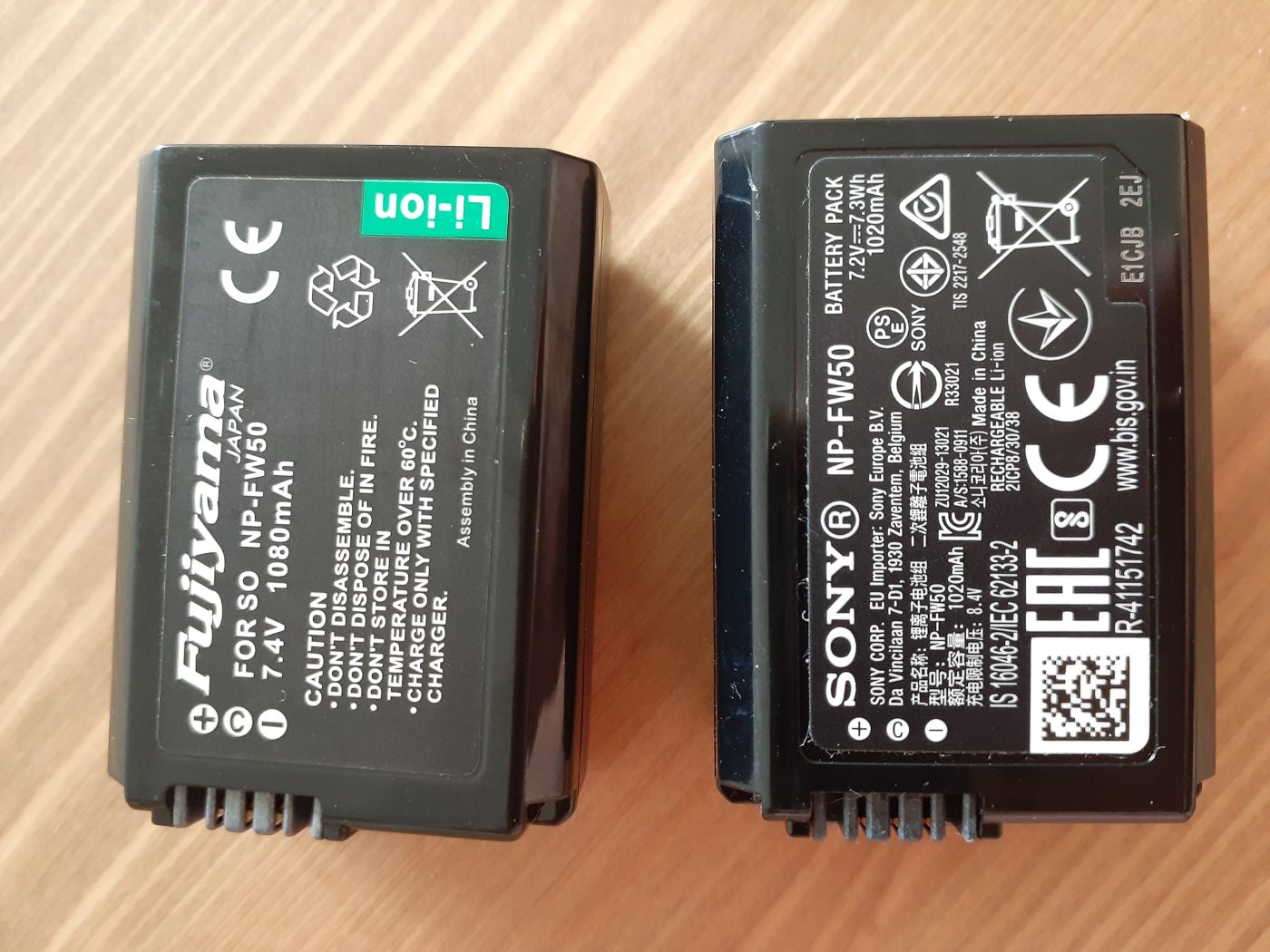
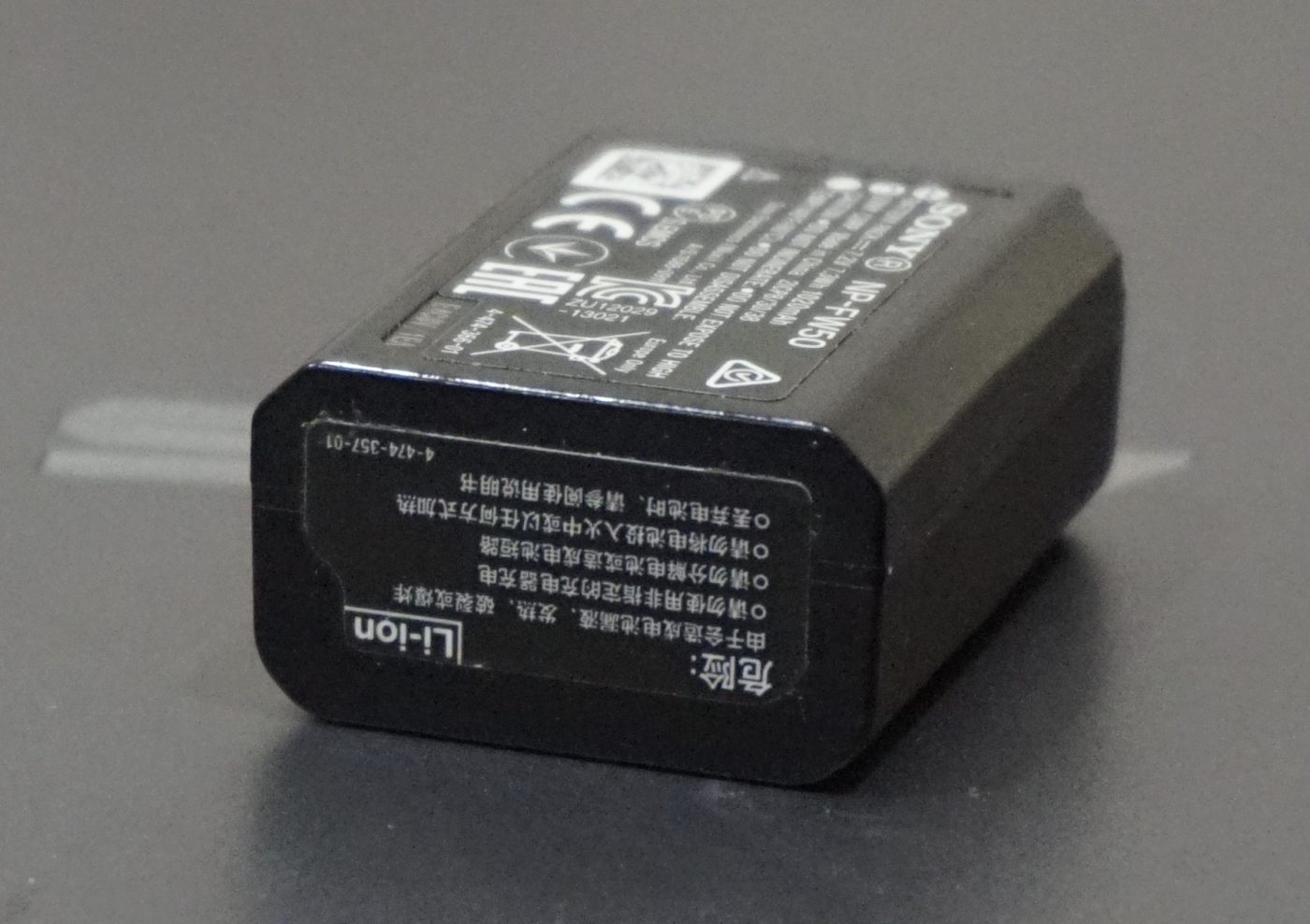
Short answer: Sony’s NP-FW50 is a 7.2V mean-output lithium-ion pack with a minimum capacity of 7.3Wh (1020mAh), measuring about 31.8 × 18.5 × 45.0 mm, in the InfoLITHIUM W series. Our compatible cell is quoted at 1100mAh typical (1050mAh rated), 7.4V and 8.14Wh. Since the voltages differ, “1100 is 80mAh more than 1020” does not describe the energy difference; convert to watt-hours and the gap is about 0.84Wh. Below, each figure is kept with its own source so the original specification and the compatible-cell specification never get mixed up.
Specification table
The left column comes from Sony’s public product pages, the right column from our NP-FW50 compatible cell listing. Neither column corrects the other; they describe two different batteries.
| Item | Sony original NP-FW50 | Our compatible cell |
|---|---|---|
| Capacity | 1020mAh minimum (7.3Wh) | 1100mAh typical, 1050mAh rated |
| Voltage | 7.2V mean output | 7.4V |
| Energy | 7.3Wh | 8.14Wh |
| Dimensions | Approx. 31.8 × 18.5 × 45.0 mm | NP-FW50 form factor |
| Weight | Approx. 42g (Sony China listing; some references say 57g) | Approx. 42g |
| Chemistry | Lithium-ion, InfoLITHIUM W series | Lithium-ion, no memory effect |
| Communication | Exchanges charge data with the body | Decoder chip for percentage readout |
| Bodies | 28 E-mount models on Sony’s list | 21-plus popular bodies stated on the listing |
One caveat on sources: Sony’s English page says “minimum capacity 7.3Wh (1020mAh)”, while the spec block on its Chinese store and several third-party references also show 1080mAh. Such differences usually come from minimum versus typical capacity labelling. For energy arithmetic, the official 7.3Wh is the safest value because it is already an energy figure.
Why mAh misleads here
Milliamp-hours measure charge, not energy. Multiply by voltage to get watt-hours. Run both figures:
- Original: 7.2V × 1.02Ah = 7.344Wh, matching the quoted 7.3Wh.
- Our cell: 7.4V × 1.1Ah = 8.14Wh, matching the listing.
- Difference: 8.14Wh − 7.3Wh = 0.84Wh, about 0.84 ÷ 7.3 ≈ 11.5% above the original.
By mAh the gap looks like 7.8%; by Wh it is about 11.5%, because the voltage is 0.2V higher too. Neither number means “11.5% more photographs” — frame counts also depend on live view, playback, flash, temperature and the share of video. What these figures establish is stored energy, not how a body spends it.
A related mix-up: a lithium-ion pack sits above its nominal voltage when full, with a charge termination around 8.4V for a two-cell series arrangement. That is why our DR-FW50 external power adapter is specified at DC 8.4V / 3A output. 8.4V is a supply or full-charge voltage, not a nominal rating; do not multiply capacity by it.
What InfoLITHIUM actually does
Sony’s InfoLITHIUM W series is about communication rather than capacity. The pack exchanges consumption data with compatible bodies and chargers, which allows a more accurate remaining-charge readout, often as a percentage or in minutes rather than a three-bar icon. This is also why third-party cells carry a decoder chip: without that exchange a body may refuse to show charge, warn about the battery, or report a jumping value.
Sony also states the cells have no memory effect, so the old “drain it fully before recharging” routine does not apply; partial charging does not cost capacity that way. What does age a cell is long-term storage at full charge in heat, deep discharge and ordinary calendar ageing, not the timing of a top-up.
What these numbers can and cannot tell you
| They can tell you | They cannot tell you |
|---|---|
| Which pack stores more energy (compare Wh) | How many frames a specific body will shoot |
| An estimate of refill time (8.14Wh ÷ power ÷ efficiency) | A percentage gain in real runtime |
| Whether the NP-FW50 form factor applies | Whether every firmware version recognises a third-party cell |
| Why a decoder chip is needed for the readout | How many cycles remain |
In short, a spec table supports selection and estimation, not promises. For duration, divide energy by average draw and allow for conversion loss; for real frame counts, look at the body and how it is used. Body-by-body articles are grouped in the NP-FW50 category.
FAQ
How much larger is 1100mAh than the original 1020mAh?
The quoted difference is about 80mAh, but the voltages differ (7.4V versus 7.2V), so mAh is not a valid comparison. In energy it is 8.14Wh versus 7.3Wh — a gap of about 0.84Wh, roughly 11.5%.
Can 7.2V and 7.4V packs be used in the same body?
Both are nominal voltages quoted for the same two-cell lithium-ion format, and a body draws to the NP-FW50 specification. Original and compatible cells share the form factor and fit the same compartment. The difference is in labelling, not the connector.
What is 8.4V, and does it conflict with 7.4V?
No. 7.4V is nominal; 8.4V is the full-charge termination voltage, or the output of an external supply. They are values of the same system in different states.
Why do some pages say 1020mAh and others 1080mAh?
Usually minimum versus typical capacity labelling, with different channels and batches quoted side by side. For calculations, prefer Sony’s direct energy figure of 7.3Wh.