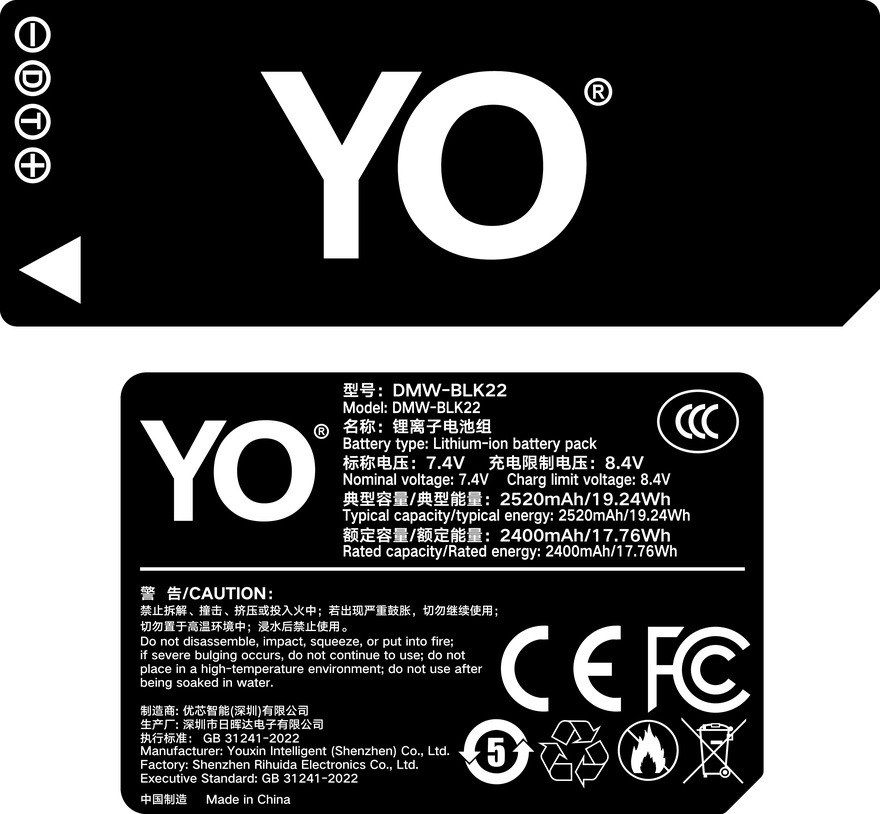
Short answer: one DMW-BLK22 gives about 90 minutes of 4K 60p on an S5 II at CIPA figures, which works out to roughly 13W of draw. At 4K 30p you get about 2.1 hours; 6K and internal ProRes drop to just over an hour. One pack does not cover a full day, and for long takes you should run USB-C PD. The pack is quoted at 2520mAh and 7.4V, 19.24Wh, with 2400mAh and 17.76Wh nominal. That is a decent amount of energy, but video drains it continuously, which is nothing like the short bursts of stills shooting.
Why video drains so much faster than stills
A still is a series of spikes. Focus, shutter, card write, each lasting a few hundred milliseconds, with the sensor and processor idling in between. Three hundred frames from one pack depends on that duty cycle.
Video is a different regime. The sensor reads out continuously, the encoder compresses continuously, the screen stays lit, stabilisation keeps correcting, and the processor watches thermals. Those blocks run at once with no gap to save power, so the draw is a flat high line. 4K 60p pushes twice the data of 4K 30p per second, and the encoder load doubles with it.
Two more costs are easy to miss. The screen is a large, bright, always-on panel and takes a real share of the total. Heat adds a little as well, since a warm body draws slightly more, and that shows up outdoors in summer.
The arithmetic: how long 19.24Wh lasts
The formula is simple: 19.24Wh divided by draw in watts gives hours. The draw figures are assumptions for the whole camera, sensor, encoder, screen and stabilisation included. They are estimates, not measurements.
- 4K 60p: 19.24 / 13 is about 1.48 hours, or 89 minutes, which lines up with the CIPA figure of 90.
- 4K 30p: 19.24 / 9 is about 2.14 hours.
- 6K open gate: 19.24 / 15 is about 1.28 hours.
- Internal ProRes: 19.24 / 17 is about 1.13 hours.
| Mode | Assumed draw | Estimated runtime | Packs to carry |
|---|---|---|---|
| 4K 60p 10-bit internal | 13W | About 1.5 hours (90 minutes) | 3 |
| 4K 30p internal | 9W | About 2.1 hours | 2 |
| 6K open gate / 5.8K | 15W | About 1.3 hours | 3 |
| Internal ProRes | 17W | About 1.1 hours | 4 |
| HDMI out to a recorder, 4K 60p | 11W | About 1.7 hours | 2 |
| Timelapse at 5 second intervals | 4W | About 4.8 hours, limited by clip length | 1 to 2 |
| Livestream on USB power | 7W | Powered, so runtime is not the limit | 1 spare |
The pack count assumes half a day to a full day of shooting, one in the body and the rest as spares. Add more if a monitor or wireless video transmitter is also drawing from the body.
6K, ProRes and recording externally
Resolution is not what sets the draw. Where the encoding happens is. In internal recording the encoder runs inside the body, and heavier compression at higher bitrates keeps the processor busier. That is why internal ProRes is the hungriest mode: high bitrate writes to a card or SSD put encoding and storage under load at the same time.
External recording moves the encoder into the recorder. The body only has to send a clean HDMI signal, so the internal encoder idles and the draw falls. The trade-off is a heavier rig, and the recorder needs its own power, though not from this pack. So external recording is easier on the camera battery without necessarily being easier on the total kit.
6K open gate sits between the two. The readout area is larger and the sensor and processor work harder than at 4K, but nothing is pinned like ProRes. If the deliverable is 4K, shooting 6K open gate and cropping leaves room in the grade, at a cost of roughly thirty percent of runtime.
Is one pack enough, and when to plug in
For short films, interviews and event coverage with stops and starts, one pack in the body plus one spare is usually enough. For continuous long takes, lectures and streaming, one pack will not cover a session, because swapping mid-take breaks the recording.
The S5 II supports USB-C PD while running, so a large PD bank lets the body record for hours with the pack acting as a buffer. Two cautions. The body runs hotter on PD, so leave room for airflow outdoors in summer. And keep the bank out of direct sun, since heat makes it derate its output.
Timelapse is its own case. Draw per frame is tiny and a pack lasts a long time, so the real limits are usually clip length and card space rather than energy. You can check capacity on the DMW-BLK22 compatible battery page, and pick a multi-pack under the same category. The original Panasonic DMW-BLK22 is quoted at about 2200mAh and 16Wh, slightly below the compatible pack, so by the arithmetic above it runs a little shorter.
FAQ
Is 4K 60p really only 90 minutes
90 minutes is a CIPA reference, measured with intermittent recording and standard brightness. Continuous takes, a brighter screen, active stabilisation or an external monitor all shorten it. Treat it as a ceiling, not a promise.
Can two packs cover a full day of event work
For event coverage built on 4K 30p with plenty of stopping, two is often enough for a day. If most of the work is 4K 60p or 6K, two covers half a day and you should plan for three or four.
Does charging while recording interrupt the clip
With a stable PD supply it does not, the body moves between supply and pack as needed. The risks are a bank that is unplugged or drained, and thermal protection kicking in. Check the cable and connector lock before a take.
Is external recording always more efficient
For the camera pack, yes, because the encoder work moves to the recorder. For the whole rig, not necessarily, since the recorder needs power of its own. Decide on image quality and workflow, not on runtime alone.