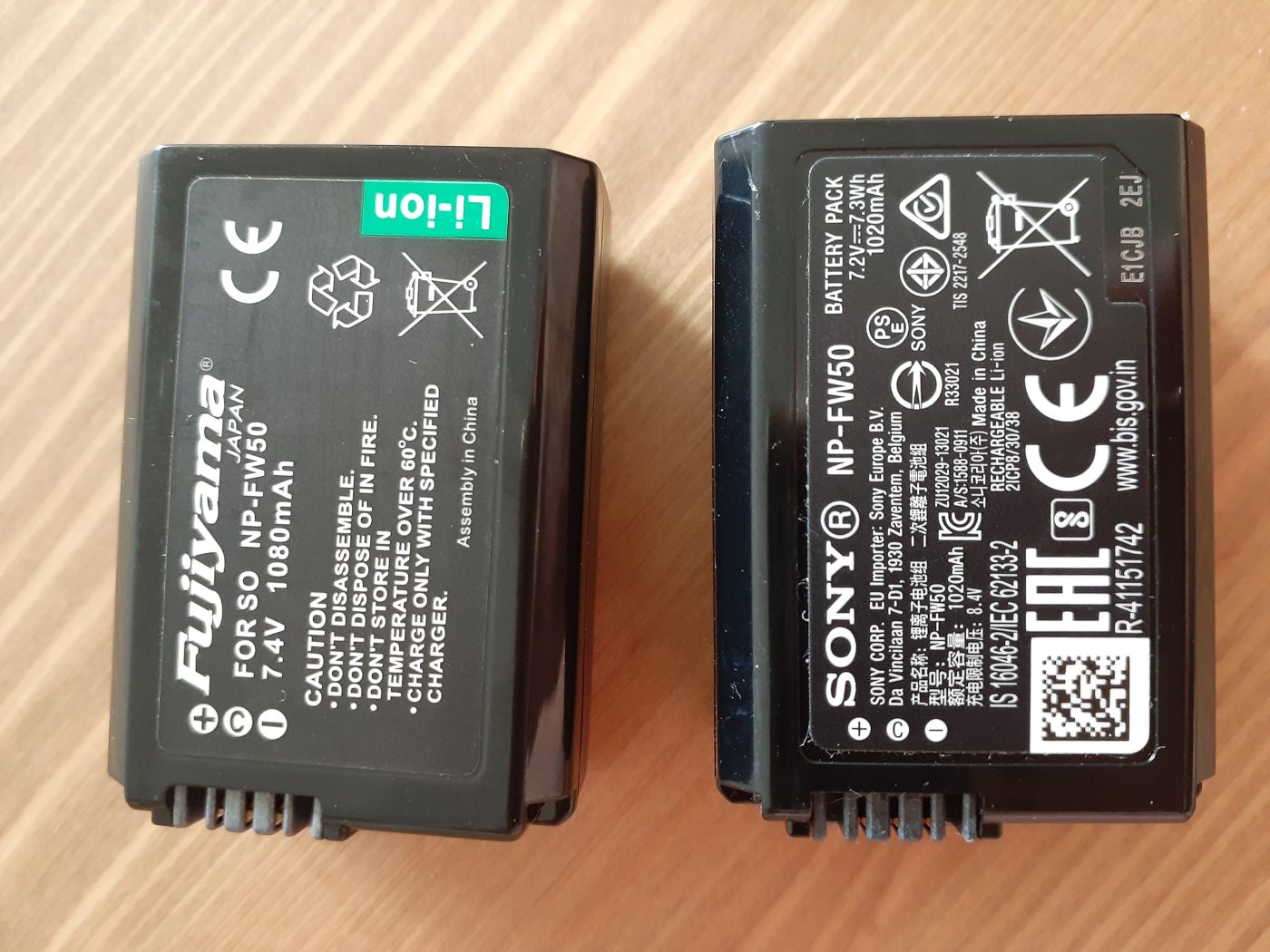
Short answer: it is worth it if you regularly recharge away from your dock, and especially on older bodies like the NEX, first-generation α7 and α6000 that cannot charge over USB. Capacity is not the difference — both versions are 1100mAh at 7.4V. The direct-charge version puts the port on the cell itself; the plain version needs a dock. If you already own a dock and only charge at fixed locations, the premium buys you very little. Our NP-FW50 is quoted at 1100mAh typical, 1050mAh rated, 7.4V and 8.14Wh. The TNP-FW50 is also 1100mAh at 7.4V, with a USB-C port built into the battery.
The difference is the charge input, not the cell
People often treat “USB-C or not” as a capacity question, but those are separate dimensions. Stored energy comes from voltage and capacity: both versions are 7.4V and 1100mAh, and our standard cell is quoted at 8.14Wh. The Type-C port is a change in where charging happens. The plain cell delegates that to an external dock; the direct-charge version builds the regulation and protection into the battery, so a cable is enough.
That also means the direct-charge version does not shoot longer. The same 8.14Wh is consumed at the same rate; a commonly quoted figure of roughly 350 frames on an α6400 does not become 500 just because the cell has a port. What improves is how you refill afterwards — a workflow and packing question.
The other easily missed point: this generation of bodies mostly has no USB power path. NEX, first-generation α7 and α6000 cannot charge the battery through the body, and cannot shoot while charging. Plain-cell owners therefore have to carry a dock; direct-charge owners carry a cable and optionally a power bank. Older bodies are where the on-cell port earns the most.
Three refill routes, with the arithmetic
Every figure uses the quoted 8.14Wh as the numerator, divides by an assumed input power, then by an efficiency of 0.8 to get hours. The power figures are assumptions chosen to make the sum readable, 0.8 is one uniform factor, and the results are estimates rather than fixed behaviour for any model. The constant-voltage tail usually adds ten to twenty minutes.
| Method | Assumed input power | Estimate (8.14Wh ÷ power ÷ 0.8) | What you carry |
|---|---|---|---|
| Plain cell + dock | 5W | 8.14 ÷ 5 ÷ 0.8 ≈ 2.0 hours | Dock plus a wall socket |
| USB-C cell + phone charger | 7.5W | 8.14 ÷ 7.5 ÷ 0.8 ≈ 1.4 hours | One USB-C cable plus charger |
| USB-C cell + power bank | 5W | 8.14 ÷ 5 ÷ 0.8 ≈ 2.0 hours | Power bank, usable on the move |
| USB-C cell + 10W supply | 10W | 8.14 ÷ 10 ÷ 0.8 ≈ 1.0 hours | Matching charger and cable |
The power ceiling is set by the charging circuit inside the cell, the cable and the supply together. A larger power bank does not shorten the times above. At 8.14Wh the refill window is already short compared with larger cells such as the FZ100, which is why carrying one more pack usually beats chasing a faster charge.
When it pays off, and when it does not
| Situation | Verdict |
|---|---|
| Older body, frequent travel, no dock wanted | Direct charge is clearly worth it |
| Dock already owned, charging only at home or hotel | Plain cell is enough; save the difference |
| Several cells rotated and charged overnight | A two-slot case solves more than one on-cell port |
| Livestreaming or long fixed-camera sessions | Neither solves it; use a DC coupler dummy battery |
| Newer bodies that charge over USB themselves | The extra port adds less |
There is also a middle path: you need not replace every pack. Keep a plain cell in the camera, add one direct-charge cell as the spare that can be topped up anywhere, and let a DR-FW50 two-slot case handle parallel overnight charging. That is usually cheaper than a full swap. Specifications are on the TNP-FW50 page and the standard NP-FW50 page.
Direct charge is not shooting while charging
Power entering the port goes into the cell; it does not simultaneously run the camera. With a cable attached the battery is still discharging, and whether the level rises depends on draw versus input. On bodies without a USB power path, a cable is not external power at all. Continuous recording still calls for a dummy battery connected to an external supply.
Safety follows ordinary practice: stop using any cell that swells, smells unusual or runs abnormally hot; store long-idle packs around half charge; keep lithium cells in carry-on luggage with terminals insulated on flights. None of this changes with a Type-C port.
FAQ
Can the direct-charge version be refilled from a power bank?
Yes, that is its main use. The bank’s output protocol, the cable and the internal circuit together set real power; at a 5W assumption the estimate is about 2.0 hours. A power bank answers where you charge, not how fast.
Can I add a Type-C port to a plain cell?
Not advisable. The battery needs charge management and protection circuitry, and modifying a lithium cell raises safety and consistency problems with no reliable safeguard. A factory-built direct-charge cell is the sound option.
Will the USB-C version still charge in a two-slot case?
Yes. It remains NP-FW50 form factor with the same contacts and shape, so it seats in a DR-FW50 case normally. The port is an additional route and does not conflict with dock charging.
Why is it recommended most for older bodies?
Because NEX, first-generation α7 and α6000 have no USB charging path, leaving plain-cell owners dependent on a dock. Moving the port onto the cell bypasses that body limitation and removes a dedicated charger from the bag.