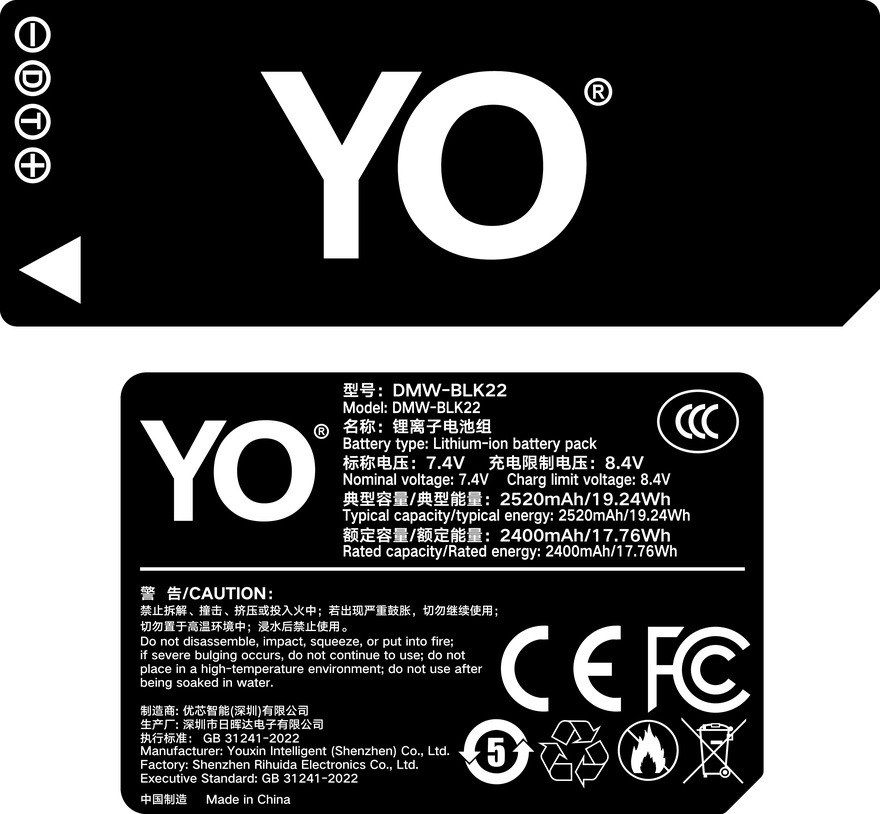
Short answer: leave the pack at 40 to 60 percent for long storage, keep it dry at 15 to 25 degrees Celsius, and top it back to half every three months. At 19.24Wh it is far below the 100Wh limit, so it travels in the cabin and, by the rules, not in checked baggage. None of this is difficult. The hard part is remembering. Most packs are not worn out by shooting, they are worn out in a drawer or scratched up in a bag next to keys and coins.
What charge level to leave it at
Storing at full accelerates ageing at the positive electrode. Held at high voltage, side reactions inside the cell run more freely and capacity fades faster. Storing empty is no better, because self-discharge keeps pulling the voltage down, and below the protection board threshold the pack may refuse to take a charge at all.
40 to 60 percent is the safe band, roughly two or three bars on the camera display. Take it out every three months and add charge to about half, then stop. The point is to prevent over-discharge, not to keep it topped up.
If the camera will sit unused for months, take the pack out. A switched-off body still draws a small standby current, and over months that quietly drains the pack without ever warning you.
Temperature and the environment
The comfortable storage range is 15 to 25 degrees Celsius, dry and out of direct sun. Do not leave packs in a parked car in summer. A closed cabin in sunlight reaches fifty or sixty degrees, and damage at that temperature accumulates. One hot afternoon may not kill a pack, but it leaves a mark.
Capacity drops noticeably in the cold. That is normal, caused by the electrolyte thickening, and most of it comes back at room temperature. What to avoid is charging a cold pack, because lithium plating on the anode at low temperature is not reversible. Coming in from a winter shoot, let the pack sit for an hour or two before it goes on the charger.
Humidity matters too. The cell is sealed, but terminals and the protection board can oxidise. In a wet season, a sealed bag with a sachet of desiccant costs almost nothing and prevents most of it.
When to retire a pack
The clearest signal is swelling. Set the pack on a flat table. If it rocks, or if it takes real force to slide into the bay, stop using it. Swelling means gas has formed inside and the structure has deformed, and further charging carries risk.
The second signal is charging behaviour. A pack should be warm, not hot. If it is uncomfortable to hold, or the charger keeps restarting between charge and idle, internal resistance has risen or the protection board is failing. Test it on another dock, and if the behaviour repeats, retire it.
The third is capacity. Usable time shortens gradually as cycles accumulate, and that is normal wear. There is no need to chase new-pack numbers. Once a pack delivers about half of what it used to and you regularly shoot long sessions, its practical value is gone.
| Symptom | Reading | Action |
|---|---|---|
| Slight bulge, rocks on a flat surface | Gas inside, shell already deformed | Stop using it, dispose of it as electronic waste |
| Loses more than a tenth in a week at rest | High self-discharge, board leakage | Check once more, replace if it repeats |
| Hot to the touch while charging | Raised internal resistance or a faulty charger | Retest on another dock, retire if still hot |
| Runtime collapses in cold weather | Electrolyte thickening, expected behaviour | Warm it up, do not charge it cold |
| Stiff going into the body | Shell swelling or tolerance drift | Do not force it, use another pack |
Flying, and organising several packs
Aviation rules count watt-hours, not milliamp-hours. The common framework allows up to 100Wh in carry-on, 100 to 160Wh with airline approval, and nothing above 160Wh; lithium-ion packs are not permitted in checked baggage at any size. At 19.24Wh this one is far below the limit and a handful in a carry-on is not an issue. Check your airline’s current wording before you fly anyway.
Protect the terminals in transit. The original plastic cap is best. Failing that, tape over the contacts or put each pack in its own pouch. Never let packs share a pocket with keys, coins or metal fittings, because a bridge across the terminals heats the cell fast.
Video shooters often carry four to six packs, and at that point sorting matters more than people expect. Three pouches by state works well: full, half, needs charging, distinguished by colour. Numbering each pack and keeping one line per pack in a phone note, first use date and rough cycle count, is the other option. On set, colour beats memory.
One habit worth building: on the way home, keep the used packs separate from the full ones. At home, bring them to half and put them away. Next time you leave, nothing you pick up is empty. Packaging and capacity options are listed under the DMW-BLK22 range.
FAQ
Can the pack stay in the camera for months
Better not. Even switched off, the body draws a small standby current, and over months that can take a pack into over-discharge. For long breaks, remove it and store the two separately.
Can a swollen pack still be used
No. Swelling means gas has formed and the structure has changed, and continued charging carries a safety risk. Stop using it and take it to a battery or electronic waste collection point, not household rubbish.
Do airports check these batteries
They can, and the check is by watt-hour. At 19.24Wh this sits well inside the usual carry-on allowance. Keep packs where you can reach them, terminals capped, so you can show them if asked. Never put lithium packs in checked luggage.
How often does it need a top-up
Every three months during long storage, to roughly half. In a warmer room the interval can be shorter, because self-discharge runs faster at higher temperature.