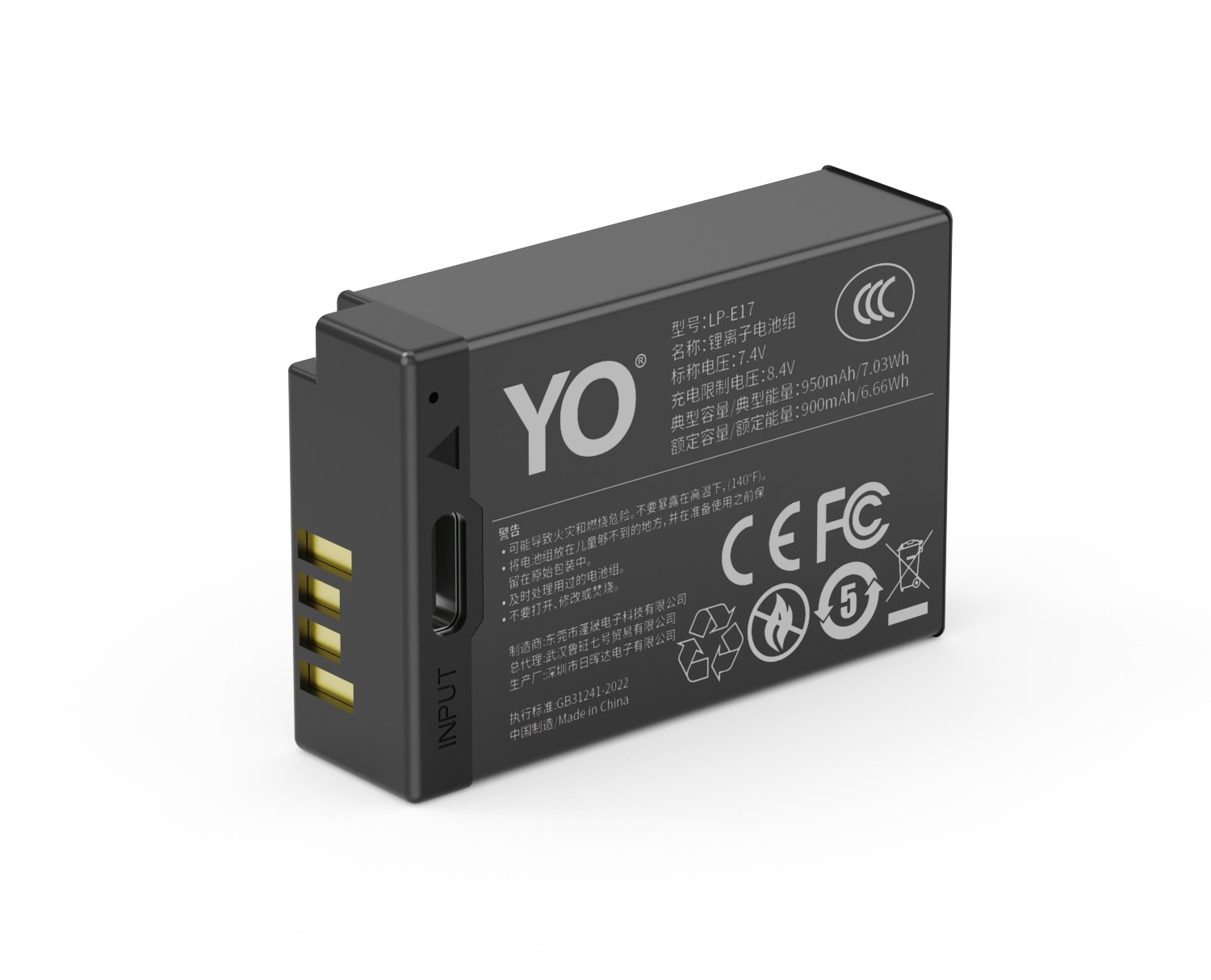
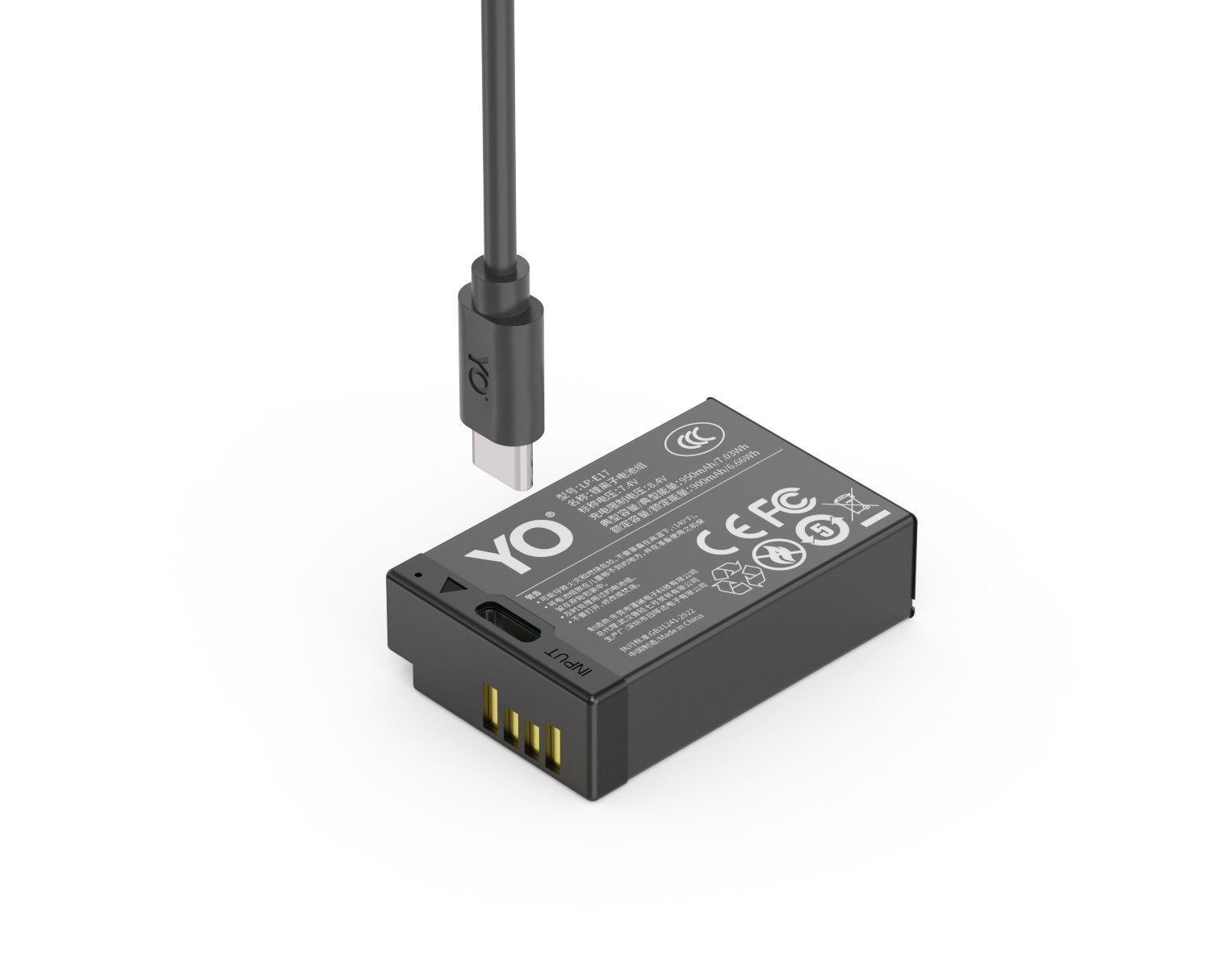
Posted on — Leave a comment

DMW-BLK22 Buying Guide: 2520mAh / 19.24Wh vs the Original DMW-BLK22

Compare watt-hours before milliamp-hours: our DMW-BLK22 compatible cell is 2520mAh / 19.24Wh, while the original DMW-BLK22 is 2200mAh / 16Wh. Milliamp-hours describe charge, not energy, so they cannot be compared across voltage platforms. Watt-hours (voltage x capacity) are the honest figure. Where a label states both a typical and a minimum rating, use the minimum for conservative runtime estimates.

By CIPA standard the S5 II delivers about 370 shots per charge (4K 60p 90 min). Real-world figures fall with viewfinder use, bursts, flash and low temperature, so budgeting around 70% of the rating is safer.

Original vs our cell, item by item

The table puts the original rating and our compatible cell on the same basis. Price is the listed retail figure; check the product page for current terms. Where a minimum rating is printed, that figure is the better basis for conservative estimates.

Item Original Our compatible cell
DMW-BLK22 2200 mAh 2520 mAh
Wh 16 Wh 19.24 Wh
mAh (min) — 2400 mAh
CNY — ¥78.3

Balancing capacity, price and warranty

Higher capacity does not double your shots: the body cutoff voltage and its fuel-gauge algorithm both shape the reading. For a spare cell, price, cycle life and warranty often matter more than the peak number.

Item Value
DMW-BLK22 DMW-BLK22
DMW-BLK22 2200 mAh / 16 Wh
dmw-blk22 2520 mAh / 19.24 Wh
S5 II 370 / 4K 60p 90 min
S1 / S1R / S1H → DMW-BLJ31 / GH5 / GH5S → DMW-BLF19 DMW-BLK22
DMW-BLK22 2520 mAh / 19.24 Wh

Choosing a kit by shooting load

For light use, one original plus one spare is enough. For a full day of travel or video work, carry two or more and rotate them through a dual-bay charger.

To pick by model, start with the specifications and stock status on Panasonic DMW-BLK22 2520mAh, then browse the full article set in DMW-BLK22; if your body belongs to a neighbouring system, BCX204 has the side-by-side explanation.

FAQ

Is 2520mAh an inflated rating?

Our DMW-BLK22 compatible cell is specified at 2520mAh / 19.24Wh. The label also states a minimum of 2400mAh. while the original DMW-BLK22 is 2200mAh / 16Wh. Compare the Wh figures rather than mAh alone.

Should I look at mAh or Wh?

Wh. Milliamp-hours only become energy once multiplied by voltage, so comparing mAh across different voltage platforms is misleading. 19.24Wh is the like-for-like baseline for this pack.

Can a higher-capacity cell damage the camera?

No. As long as the shell, contacts and protection circuit match the system, capacity only affects runtime. The one caveat is that older bodies may report charge level inaccurately.

Should I buy one cell or two?

For a full day outside or video work, carry two or more and rotate them through a dual dock. For indoor or short sessions, one original plus one spare is enough. Budget conservatively against the S5 II baseline.

Posted on — Leave a comment

Can You Fly With NP-FZ100 (USB-C) Batteries? Carry-On Rules

Short answer: yes. The NP-FZ100 (USB-C)’s rated energy is about 16.4Wh, far below the 100Wh cabin threshold, so it can travel with you on both domestic and international flights without airline approval. One hard rule still applies: spare lithium batteries go in carry-on only, never in checked baggage. The contacts also need protection against short circuits, and the quantity has to stay within what is reasonable for personal use. Below we separate the arithmetic, the energy bands and the practical security routine so you can tick them off before you leave.

YO NP-FZ100 camera battery render
Product render of the YO NP-FZ100 compatible battery: front label, rear LED charge indicator and USB-C port.

Where 16.4Wh comes from

Aviation rules work in rated energy, in watt-hours, not in milliamp-hours. The formula is capacity times voltage divided by a thousand: 2280mAh × 7.2V ÷ 1000 ≈ 16.4Wh. That is the original NP-FZ100 rating, and the NP-FZ100 (USB-C) is built to the same specification, so it lands in the same bracket.

The point is worth stressing because people often compare a 20,000mAh power bank with a 2,280mAh camera battery and conclude that the camera battery is “tiny, so obviously fine”. The conclusion is right but the reasoning is not: a power bank is rated at 3.7V cell capacity, so 20,000mAh comes to about 74Wh, still inside 100Wh; at 27,000mAh you are close to the ceiling. Convert to Wh before comparing and the milliamp-hour figure will not mislead you.

The three energy bands

Rated energy Cabin allowed Requirement
Up to and including 100Wh Yes No approval needed, quantity within personal use
100Wh to 160Wh Yes, with approval Airline consent required, usually limited to two
Above 160Wh No Prohibited in the cabin and in checked baggage

The NP-FZ100 (USB-C) falls in the first band, the least restricted category. Most carriers limit first-band spares to a quantity reasonable for personal use; IATA guidance is commonly twenty per passenger, individual carriers may be stricter, and their published rules take precedence. Five or six packs for a shoot rarely raises a question; a case of identical batteries invites one about what they are for.

Cabin or hold: the rule people get wrong

The distinction turns on the state of the battery. A pack installed in a camera, with the camera switched off and protected against accidental activation, can generally travel in checked baggage with the equipment. Spare packs carried separately must go in the cabin. The reason is that a short-circuit fire in the hold cannot be dealt with by the crew in time; in the cabin it can.

In practice, packing every battery into the checked suitcase is the common mistake. The correct split is one pack in the body, the rest in your carry-on bag, and power banks in the cabin as well. This holds for domestic and international flights alike, and virtually every carrier applies it.

Contact protection: what security is really looking at

The hazard in a lithium battery is the positive and negative terminals being bridged by metal at the same time. Loose in a bag with keys and coins is the textbook short circuit. Any one of three accepted measures will do.

  • Keep the original packaging, one pack per slot — factory state is the safest.
  • Tape over the metal contacts with insulating tape, or fit the supplied plastic cap.
  • Put each pack in its own zip bag or battery case so they cannot touch.

A dual-slot charging case works too: the shell isolates the contacts and the closed lid doubles as storage, at the cost of a little more bulk than loose packs. For how these accessories are used, see our dual-slot case guide.

The practical order of operations at security

  1. Before leaving, gather the batteries into one inner pocket of your carry-on rather than spreading them across three bags.
  2. Confirm every pack is protected — original box, tape or a bag — with no exposed contacts.
  3. If you are asked, say plainly that they are camera spares, and show the camera if it helps.
  4. Do not put batteries in a metal case; metal reads as a muddle on the scanner and invites a hand search.
  5. Once aboard, do not use a power bank to charge batteries; some carriers explicitly prohibit power bank use in flight.

Most of the time the X-ray shows a few neat rectangular blocks travelling with a camera, and the officer can identify them at a glance without further questions. What gets stopped is loose packs, unprotected packs and unusual quantities.

Edge cases that come up often

On a connection through a third country, local civil aviation rules apply. Most align with the standard, but a few regions are more sensitive about quantity, so on long multi-leg itineraries keep the count to four or fewer. International check-in desks occasionally ask to see the markings; a pack worn too smooth to read is easy to refuse, which is another argument for keeping the original packaging.

As for the battery’s own condition, capacity, temperature and swelling all matter. If the shell is visibly bulging before departure, do not board with it — that is a replacement signal. For more on judging battery condition and body compatibility, see the NP-FZ100 (USB-C) section. If you are travelling with a full kit, the longer NP-FZ100 flight guide covers the rest.

FAQ

Will six NP-FZ100 (USB-C) packs be stopped at security?

Usually not. Six come to roughly 98Wh in total, still within personal use, provided they are split across your carry-on and the contacts are protected. If you are carrying a dozen or more, it is worth preparing a commission letter or an itinerary in case you are asked.

Can batteries go in checked luggage?

Spares cannot. A pack installed in a device that is switched off and protected against activation is accepted by most carriers. When in doubt, keep it in the cabin — that choice is never wrong.

The shell is scuffed and the ratings are unreadable — can I still take it?

There is a risk of refusal. Security needs to verify rated energy and may decline carriage when the marking cannot be read. Replace the pack with one that has an intact shell, or keep the original packaging as evidence of the specification.

Can I bring a power bank and camera batteries together?

Yes. Both are managed as spare lithium batteries and both travel in the cabin. The difference is that a power bank must keep a legible capacity marking and is usually banned from use in flight; camera batteries have no in-use restriction but still cannot be checked.

Posted on — Leave a comment

DR-FZ100 Car Charging: 12V Sockets, PD Adapters, Long Drives

Short answer: yes. The DR-FZ100 takes USB input, so a 12V socket adapter with a USB output can top up two NP-FZ100 packs while you drive — roughly 4 to 6 hours for both, or 3 to 4 hours with a PD-capable adapter. The question is not whether it can be done, but which adapter you use, how the case copes with the voltage dip when the engine cranks, and how hot the cabin gets in summer. What follows covers the power path, adapter choice and a charging rhythm for the road.

How the power chain works in the car

The chain runs: 12V socket, adapter stepping down to 5V (or negotiating a higher PD voltage), USB cable, charging case, battery. If any link is weak, the symptom is always the same — slow charging or no charging at all.

The second link is the one people overlook. A cheap adapter rated at 2.4A can drop below 1A when the supply voltage sags; the case keeps charging but crawls. That is not the case’s fault, and a different adapter fixes it.

Choosing a car adapter

Three criteria, in order of importance: output stable at 2A or above, independent over-voltage and over-current protection, and PD output support. The first two decide whether charging is reliable; the third decides how fast it is.

Adapter type Typical output Two packs, full Where it fits
Old single-port adapter 5V/1A About 6-8 hours Not recommended, emergencies only
Dual-port adapter 5V/2.4A per port About 4-6 hours Fine day to day, phones as well
PD adapter 20W and up About 3-4 hours Long trips, multi-battery rotation

With a dual-port adapter, watch the split: plug in a phone and the case together and each takes half the output, so the case charges noticeably slower. If you are in a hurry, run the phone from a power bank and let the adapter feed the case alone.

The voltage dip at startup

When the engine turns over, battery voltage sags briefly to around 9V before recovering. Many adapters restart at that point, and the charging case drops out and resumes with them. Once is not a problem, but a dozen restarts a day is not kind to any charging circuit.

The fix is simple: plug the adapter in after the engine is running, and unplug it before you switch off. That habit also solves a second problem — it stops the adapter drawing from the car battery during long stops.

As for whether charging with the engine off will flatten the car battery, the arithmetic settles it: two NP-FZ100 packs total around 33Wh, and with conversion losses perhaps 50Wh. Against a car battery of 45Ah or more that is a rounding error. The real risk is not these two packs but leaving the adapter plugged in and drawing idle current for days, which shows up quickly on a battery that is already tired.

A charging rhythm for long shoot days

The idea is to put charging inside time you were already spending behind the wheel, rather than hunting for a socket on arrival. A three-hour drive is enough to take two packs from empty to full.

  1. Charge everything at home the night before, so the car is only replacing what you used, not starting from zero.
  2. Plug in as soon as you get in, and put the case somewhere ventilated near the passenger footwell rather than on the dashboard under the windshield.
  3. Half an hour before your first location, feel the case and confirm at least one slot has gone green.
  4. Between setups, drop used packs straight back into the case and keep charging on the way home, so the cycle continues.
  5. On multi-day trips, top everything up once each evening from the hotel socket, in case one day’s drive was too short to finish the job.

The point of the routine is never to let all your packs run down at once. One full, one in the camera, one on charge is enough to carry a normal day of moderate shooting on three packs.

Summer cabin heat is the real risk

A closed car in direct sun can reach sixty degrees or more. Charging at that temperature will at best trigger thermal throttling and at worst pause altogether. Worse still, long storage at high temperature accelerates cell aging invisibly; a few months later the capacity is visibly down.

Three practical rules: keep the case off the dashboard, the rear parcel shelf and the area around the gear lever, where sun lands directly; if you park for more than half an hour, put the case in the glovebox or take it with you; and if it feels properly hot to the touch while charging, stop, let it cool, then resume.

The same applies to the packs themselves. A camera bag left in the car with spare batteries inside is a common and genuine cause of early capacity loss. Cold is the opposite problem, and the cold-weather test covers that in more detail.

Working alongside video shooting

On a long trip shooting video, packs drain far faster than they do for stills, and topping up in the car may not keep pace. When that happens, external power at fixed positions plus batteries on the move is the steadier combination; the FX3 and FX30 power setup covers the options.

For the case’s own specifications, how to read the indicator lights and day-to-day care, see the dual-slot charger section, which has the full operating notes.

FAQ

What if one 12V socket is not enough?

Use a one-to-two socket splitter, but keep the total draw inside what the car’s wiring is rated for. Most cars fuse the socket at 10A to 15A, which comfortably covers two adapters and a dash cam, but do not hang a high-power inverter off it.

Will the case work on rough roads?

Yes — once a pack is seated it will not work loose. Still, tuck the case into a seat gap or a storage bin so it does not fly out under braking. On long stretches of bad road, dust collects on the contacts, so wipe them with a dry cloth every so often.

Can I leave it charging with the adapter plugged in while I am away from the car?

Briefly, yes; for long periods, no. The car battery keeps discharging, and charging unattended in a hot cabin in summer is a risk. If you are stepping out, take the case or unplug the adapter.

The adapter says 3A, so why is charging so slow?

The rating is a theoretical peak. Real output depends on the cable, contact resistance at the plug and how stable the car’s voltage is. A short, thick cable plugged straight into the socket rather than into an extension often fixes it immediately.


Posted on — Leave a comment

LP-E17 1050mAh Guide: Runtime Gain and Weight Cost

YO LP-E17 相机电池

Short answer: 1050mAh is the highest of the three LP-E17 capacities YO offers, and only about one percent above Canon’s original at roughly 1040mAh. The real gain shows up against the 750mAh version, where the difference is about forty percent. The cost is a slightly heavier pack and a slightly higher price, and neither is significant at the LP-E17 form factor. Put another way: if you are moving up from an old 750mAh pack, the change is perceptible; if you already carry an original LP-E17, this tier gives you headroom, not double.

YO LP-E17 camera battery render
Product render of the YO LP-E17 compatible battery: front label, rear LED charge indicator and USB-C port.

First the three tiers in one table, then where the gain actually lands, then which bodies benefit most, so you do not pay for capacity you will never use.

Where 1050mAh sits in the three-tier lineup

The LP-E17 comes in 750, 950, and 1050mAh. That is a YO lineup of its own and does not map to any Canon model number, because Canon officially makes only the LP-E17, rated around 1040mAh / 7.5Wh / 7.2V. Keeping both in view is what stops “1050 is bigger than the original” from misleading you.

Version Rated capacity Derived energy (at 7.2V) Relative to the original rating Typical role
Canon original LP-E17 About 1040mAh About 7.5Wh 100% Reference point
LP-E17 750mAh 750mAh About 5.4Wh About 72% Backup, light top-ups
LP-E17 950mAh 950mAh About 6.8Wh About 91% Everyday primary
LP-E17 1050mAh 1050mAh About 7.6Wh About 101% Long days out, fewer swaps

The Wh figures are rough calculations from nominal voltage. Usable energy also depends on the discharge curve, the body’s cutoff voltage, and protection-board efficiency, so this table is for comparison across rows, not a formula for how many frames you will gain. The percentage column is a ratio of ratings, not of real runtime.

How much runtime you actually gain

Going from 750mAh to 1050mAh is a forty percent increase in rated capacity, which in practice is the difference between swapping three times and swapping twice. Going from 950mAh to 1050mAh is about ten percent, which you will not feel in daily shooting unless your day happens to sit right on the line. Against the original 1040mAh the two are essentially level, and the gap is buried under cell age and unit-to-unit variation.

Actual frame counts depend on how you frame, stabilization, screen brightness, burst frequency, and ambient temperature. The same battery might deliver six or seven hundred frames on an 850D used mostly with the optical finder, and only three or four hundred on an R8 using the electronic finder throughout, with a further discount outdoors in winter. A safe expectation is somewhere between five and seven hundred frames, moving with the body; no absolute “one battery equals N frames” claim holds.

Swap counts make it clearer. Suppose a body gets five hundred frames from a 950mAh. Scaling roughly, the ten percent a 1050mAh adds is about fifty frames, just enough for one more group photo. A 750mAh in the same conditions would give about four hundred, a gap of an entire shooting block. So the comparison worth making is 750 against 1050; between 950 and 1050 there is only a small margin.

The weight cost: you are adding cell, not shell

Within one series, higher capacity means a larger and heavier cell. The 1050mAh is usually under fifteen grams heavier than the 750mAh and close to the original LP-E17. On a single pack that is imperceptible, but four packs in a bag or long handheld sessions on a small body like the R50 turn it into a noticeable amount.

Conversely, the LP-E17’s physical size means a high-capacity version cannot add much weight: it has to fit the same compartment, and the structure and protection board are largely shared. So “high capacity means heavier and clumsier” is overstated at this form factor. Price, supply, and consistency are worth more of your attention than the feel.

Which bodies benefit most from 1050mAh

  • Full-frame EOS RP and R8: the sensor and finder draw more, so the headroom in one pack directly determines whether you dare leave with only two.
  • R10, R50, R100: small bodies with shallow grips make frequent swaps disruptive to your rhythm, and more capacity means fewer of them.
  • 850D, 800D, 760D, 750D, 77D, 200D, 200D II: built around the optical finder with low draw, so a 1050mAh lasts a long time, the kind of pack you fit and stop thinking about.
  • M6, M6 Mark II, M5, M3: mirrorless designs with a high proportion of screen framing, where the capacity gain is easier to feel.

If you shoot a few hundred frames occasionally and have a dock at home for topping up, the 950mAh is better value; if a single outing runs all day with no convenient charging, the 1050mAh’s headroom is what pays off. Check the body list against the LP-E17 capacity and compatibility guide, or go straight to current specifications in the 1050mAh category.

FAQ

Does 1050mAh last longer than the original Canon LP-E17?

The rating is only about one percent higher, so theoretically they are on the same level. Real performance depends more on cell age, protection-board losses, and operating temperature; do not expect a noticeable runtime increase.

Can the original LC-E17 charge a 1050mAh?

Yes. The LC-E17 is Canon’s dock charger for the LP-E17 and works by voltage rather than capacity, so a larger pack simply takes longer to fill.

Will 1050mAh make the body run hotter?

Not in normal shooting. Body heat comes mainly from bursts, long recordings, and internal resistance, not from the capacity tier. If the battery itself is noticeably hot at idle, stop using it and have it checked.

Does this battery work in the EOS M50?

No. The EOS M50, M100, and M200 take the LP-E12, which is not interchangeable with the LP-E17. Check your body model before buying.

Posted on — Leave a comment

Will the T Series USB-C Port Wear Out? Long-Term Reliability

YO LP-E17 相机电池

Short answer: yes, you can rely on it long term, but how you treat it matters. The Type-C socket is a mature standard part in consumer electronics and is typically rated for several thousand insertions, so at one charge a day it will not fail from repeated use over several years. The real wear comes from dust, sweat, forcing the plug in at an angle, and the plug end of the cable wearing out first. The caveat is that the port sits on the battery: once contact degrades, what you lose is not a cable but the whole pack’s charging path.

YO LP-E17 camera battery render
Product render of the YO LP-E17 compatible battery: front label, rear LED charge indicator and USB-C port.

A port on a battery is not the same as a port on a phone

A phone’s Type-C port sits behind a full main board and a water-resistance structure, and it can be repaired on its own. A port on a battery is soldered directly to the protection board, in less space, with no sealing around it and no serviceability. That means lower tolerance for debris and for mechanical stress.

Where it is used differs too. A phone usually charges lying flat with the cable supported; a battery often charges with the pack in one pocket, the power bank in another, and the cable under tension, so the port takes lateral rather than axial load. Lateral load is the direction the solder joints like least.

One more point that is easily missed: the battery is a consumable. If a phone port fails you get it repaired; if a battery port fails most people replace the pack. So the question of long-term reliance is really whether the port’s life will be shorter than the cell’s.

Habits that clearly accelerate wear

First, plugging in with grit present. Sand or lint from a pocket, the bottom of a camera bag, or a beach gets pressed between the contacts when the plug goes in. Once or twice is harmless; repeated, it raises contact resistance. The symptom is charging that cuts in and out, or needing to rotate the plug to make contact.

Second, angled and forced insertion. Pushing without aligning scrapes the plug shell against the socket wall, and over time the fit loosens. Once loose, the plug wobbles under its own weight and charging stability collapses.

Third, the cable. Cheap cables have wide dimensional tolerances on the plug, so they fit too loosely or too tightly. Too loose causes arcing; too tight stretches the opening. A budget cable inserted and removed for months can do more damage to the port than the battery itself.

Fourth, heat. Charging with the pack sealed in a bag or left in a sun-heated car keeps the plastic and solder joints near the port at high temperature for long periods, and mechanical strength declines. This has nothing to do with capacity or brand; it is a weakness shared by all lithium-ion packs.

Four warning signs you can check

Sign What it means What to do
The plug wobbles side to side once inserted Socket wall worn, retention lost Try another cable first; if still loose, the port is worn
It only charges at a particular angle Oxidized contacts or debris Power off and clear with air; never probe with metal
Charging repeatedly disconnects and reconnects Unstable contact resistance, or a broken conductor in the cable Cable first, then charger, then suspect the battery
Plastic around the port is yellowed or deformed Prolonged heat or high current Lower the charging power and avoid charging in direct sun

The order of that troubleshooting matters: cable, charger, battery, from cheapest to most expensive. Many people conclude the battery is dead when a new cable would have fixed it.

If you plan to rely on direct charging, do this

  1. Use one or two short, good-quality cables and keep them for this purpose. Fewer cables means more predictable plug wear.
  2. Hold the plug body when inserting or removing; do not pull the cable. Make align-then-push a habit, and treat a slight detent as confirmation it is seated.
  3. Put a dust cap on the port when it is not in use. Silicone caps cost very little and block most lint and sand.
  4. Use an ordinary 5V charger; do not chase wattage. Input voltage sits at 5V, so more power buys nothing but heat.
  5. Charge in a ventilated place, not at the bottom of a bag or under clothing.
  6. Blow the port out with air every few months. If you see debris, do not dig at it with a needle or toothpick; the contact springs are easy to bend.

Follow these and three to five years of trouble-free direct charging is a reasonable expectation. Conversely, if you habitually carry the pack loose in a pocket with your keys and coil the cable into your bag, the port will very likely fail before the cell does.

The T series was designed to free replenishment from the dock: one battery, one phone charger, and one power bank are enough to recharge in the field, in the car, or at a hotel, with no LC-E17 to pack. That is the most substantive difference from a standard LP-E17. If you are still deciding whether this form suits you, see the T series category, then confirm fitment in the capacity and compatibility guide.

FAQ

How many insertions can a Type-C port take before it fails?

A standard socket is typically rated for several thousand, far more than a battery will see in real use. At one charge a day you will not approach the limit for years. What causes early failure is dust, angled insertion, and poor cables, not the count itself.

If the port breaks, is the battery still usable?

It depends on the design. If the pack can also charge on a dock, losing the port only costs you direct charging and it can still be replenished normally. If direct charging is the only route, losing the port effectively scraps it. Check the product documentation for what is supported.

Can I use a phone fast charger on the T series?

In most cases yes, because input settles at 5V and the charger drops to the voltage you request. Do confirm that the charger does not enter a protective sleep at low power; some high-wattage units cycle on and off with small loads, which shows up as charging for a while and then stopping.

Does relying only on direct charging shorten the battery’s life?

No. Charging method affects longevity far less than temperature and depth of discharge. As long as charging does not overheat the pack and it is not stored full for long periods, direct charging and dock charging differ very little in cycle life.

Posted on — Leave a comment

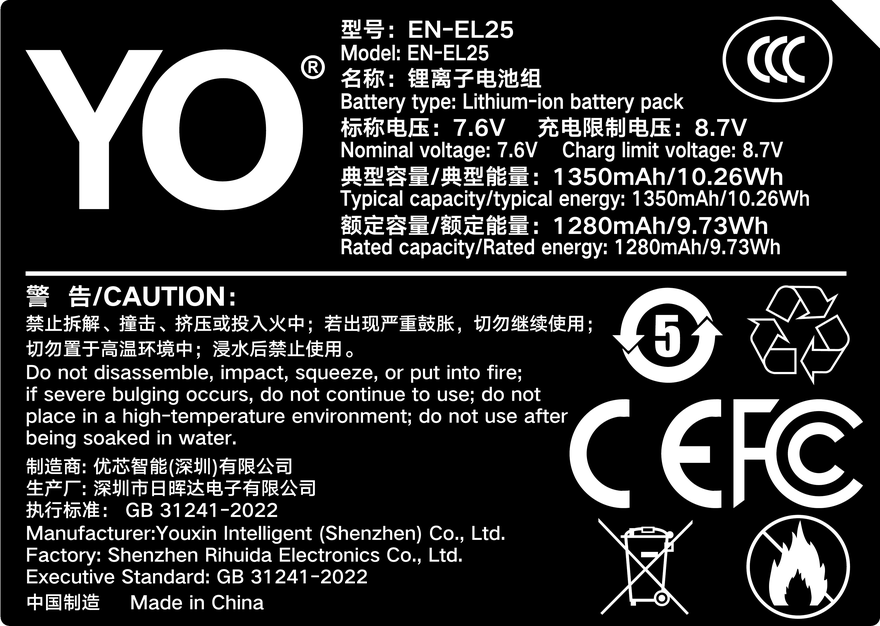
How long can a Z50 / Zfc record video on one EN-EL25 battery? Runtime math and spare counts

Direct answer: on estimates, one 10.26Wh EN-EL25 compatible battery records roughly 2 hours at a 5W total draw, or about 1.3 hours at 8W. CIPA photo ratings cannot be applied to video; video runtime should be calculated from power draw. For a full day of 4K, plan on around five batteries. All durations below are paper estimates, not measured results.

YO EN-EL25 battery rating label
Rating label of the YO EN-EL25 battery: nominal voltage, typical capacity and safety certifications.

CIPA shot counts and video runtime are different things

The most common battery figure is the CIPA photo rating: under a standardized test routine of half-presses, playback and power cycles, how many shots one battery delivers. That is useful for “will one battery cover a day of stills”, but nearly meaningless for video.

The reason is that video works completely differently: sensor, processor and screen run at full load continuously, with none of the stills shooting’s pauses. Meanwhile many of the biggest power consumers in the CIPA routine — constant focusing, playback, restarts — never happen during video. The correct approach for video is to calculate from power: battery energy divided by total draw gives the approximate recording time.

What 10.26Wh buys you: the math

The EN-EL25 compatible battery covered here has a typical energy of 10.26Wh (rated 9.73Wh). There is no single official figure for total camera draw, so two common estimate levels are used below. Emphasizing again: these are estimates, and real times will drift with temperature, resolution, stabilization and shooting habits.

  • At a 5W draw: 10.26Wh ÷ 5W ≈ 2.05, roughly 2 hours of recording.
  • At an 8W draw: 10.26Wh ÷ 8W ≈ 1.28, roughly 1.3 hours (about 77 minutes) of recording.

The gap between the two levels is more than half an hour, which is exactly why “video runtime” is not one fixed number. The direction of experience: 1080p, low screen brightness and intermittent shooting lean toward the 5W level; 4K, full stabilization and continuous takes lean toward — or beyond — 8W. For conservative planning, use the 8W level across the board.

Clip limits and overheating

Even with battery to spare, a single clip can be cut short by two factors. The first is heat: video recording heats the body continuously, and in warm surroundings or at high-bitrate 4K the camera may warn of overheating and restrict recording earlier than expected. That has nothing to do with the battery, but it directly compresses the real runtime per battery. The second is routine limits: some bodies impose a maximum length per clip and split recordings automatically. Splitting itself costs no extra power, but idle drain between segments still counts.

The countermeasures are ordinary: let the body cool between takes, lower screen brightness, and switch stabilization off when it is not needed. None of these add capacity, but they help actual recording time approach the estimate.

How many batteries a shooting day needs

Applying the math above to a shooting schedule gives the table below. The principle is to err on the generous side, because cold weather and battery aging both push real runtime below estimates.

Shooting type Approximate draw Batteries needed
A day of mostly stills CIPA basis, well below video 1 in body + 1 spare
Half a day of 1080p video (about 4 hours) 5W estimate: 10.26Wh ÷ 5W ≈ 2 hours per battery 2
Half a day of 4K video (about 4 hours) 8W estimate: 10.26Wh ÷ 8W ≈ 1.3 hours per battery 3
A full day of 4K video (about 8 hours) Same 8W estimate About 5

Err toward carrying more spares: at ¥131.40 per battery for the EN-EL25 compatible model covered here, an extra two or three is not a large cost. Product details are on the product page, and charging and power options for the same bodies are summarized in the category page.

FAQ

Why does the official runtime differ from my calculation?

Official figures use their own test conditions and power assumptions — a different basis from the 5W / 8W estimates here. The two can only be compared directionally, not converted.

Can USB power while recording fully replace spare batteries?

No. Power during recording is unavailable on some bodies, and heat plus the risk of a power drop make it fragile. Treat external power as a supplement and battery rotation as the backbone.

Rated 9.73Wh is less than the typical 10.26Wh — which should I use?

The typical value reflects ideal conditions; the rated value is closer to the guaranteed floor. For conservative planning use 9.73Wh, which at 8W gives about 1.2 hours.

Should I carry extra batteries in cold weather?

Cold noticeably reduces usable capacity. For outdoor winter shooting, carry at least one battery beyond the table and keep spares close to your body for warmth.

Posted on — Leave a comment

TNP-W126S Long-Term Capacity Loss and Replacement

Short answer: capacity loss in a lithium battery like the TNP-W126S is gradual, and the measure is not “how many years” but three things — how far the frame count has fallen in a fixed scene, how many bars disappear after a full charge sits unused, and whether the shell has begun to bulge. Industry experience puts capacity at around 80% of original after 300-500 cycles; when runtime drops below seventy percent of what it was, or the battery runs hot on charge or the shell swells, it is time to replace it. The mechanics, the tests and the timing are set out separately below.

YO TNP-W126S battery rating label
Rating label of the YO TNP-W126S battery: nominal voltage, typical capacity and safety certifications.

Start with a premise that is easily overlooked: battery life has two dimensions — cycle life, meaning how many charges and discharges, and calendar life, meaning aging while sitting idle. The two compound, which is why the same model can be in very different shape after two or three years in different hands. It is also why a battery bought and barely used can still deteriorate after three or four years on a shelf.

Why a lithium battery slowly “shrinks”

The capacity of a lithium-ion cell comes from lithium ions that can shuttle back and forth between the electrodes. Every cycle, a small fraction takes part in side reactions: forming and thickening a passivation layer on the anode surface, or becoming locked up by electrolyte breakdown products and no longer available to cycle. Fewer freely moving ions means less usable capacity. The process runs fastest when full charge, high temperature and long dwell time coincide.

So the same battery kept full in a hot car over a summer and one kept at half charge in a drawer will differ clearly after a year. That is why most manufacturers suggest storing at 40%-60% rather than full: at high charge the cathode sits at a high potential and the electrolyte oxidizes and decomposes more readily.

Fujifilm’s 7.2V / 1260mAh / 8.7Wh battery is not large, and in bodies like the X-T3 or X-Pro3 it sits close to the screen and processor, which are already warm during continuous video or high-speed bursts. A battery that works in a warmer environment much of the time will age somewhat faster than one in a larger body — a consequence of the structure, not a defect in any particular unit. If your body is actually an X-T4, X-T5 or X-H2 type using the NP-W235, the battery is entirely different; see the NP-W235 category.

Three tests that need no instruments

  1. Count frames in a fixed setup. Lock everything down: single-frame drive, AF-S, LCD framing, stabilization and flash off, room temperature. Shoot once with a new battery and record the count, then repeat with the same battery months later. Around seventy percent of the original means wear is well advanced; at half, it is ready to be a backup.
  2. Watch how fast bars drop after a full charge sits idle. Charge it full, take it out, leave it at room temperature overnight, then refit it. A healthy battery is usually still full or down one bar. Two bars gone overnight, or a low-battery warning the moment it goes in, points to increased self-discharge and higher internal resistance.
  3. Check the shell and the temperature rise. Set the battery flat on a table; all four corners should sit down without rocking. If it runs noticeably hotter on charge than it used to, or the shell bulges slightly or a seam has opened, stop using it.

None of this needs specialist equipment, but a single result proves nothing. Cold, bursts, stabilization and heavy review all lower the frame count temporarily, so repeat two or three times before drawing a conclusion, ideally with the same lens and the same scene.

Symptoms and what to do

What you observe What it roughly means Advice
10%-20% fewer frames than new Normal aging Keep using it; avoid storing it full for long periods
30% or more fewer frames Clear capacity loss Demote to backup and put a new one in the main slot
Two bars gone after a night at full High self-discharge, raised internal resistance Repeat the observation two or three times; retire if needed
Abnormally hot on charge High internal resistance or a protection board fault Stop using it and do not charge it again
Shell bulges, seam opens Gas inside; a safety risk Retire immediately and recycle properly

When to replace, and when to keep

My advice is to keep the main slot for the one or two batteries in the best condition and rotate by performance rather than by purchase order. A battery that only delivers half its original frames will force a swap mid-shoot if it stays in the main role, which leaves you worse off; but if it looks fine and does not run hot, and can carry a short outing, keeping it as the third battery in the bag is reasonable.

Only one condition demands immediate retirement: swelling. A bulging lithium battery is generating gas internally, and continued charging and discharging carries a fire risk. Do not pierce it to release gas, do not press it flat under a weight, and do not leave it on a charger; take it to your local battery recycling channel. For buying and body compatibility, see the TNP-W126S category page; the genuine model of the same series is described on the NP-W126S category, and the two share the same shape and compatible bodies.

Everyday habits that slow the decline

  • Store at 40%-60% during long disuse; do not keep it full, and do not run it to shutdown before storing.
  • Avoid heat: a car dashboard, a heater vent and a sunny windowsill are all unsuitable.
  • Top up every three months so long-term self-discharge does not drag the voltage too low.
  • Rotate several batteries so that none goes through repeated deep cycles.
  • Use a reputable charger, or the battery’s own USB-C port, and avoid long sessions on a fast charger of unknown origin.

Third-party batteries such as YO’s are capacity-matched in pairs at the factory, and batches with better consistency behave more evenly when rotated. But all five points above apply equally to genuine and third-party products — the cell chemistry is the same.

FAQ

How long before a TNP-W126S must be replaced?

There is no fixed term. By cycle count, most people reach 300-500 within two or three years and enter the 80% capacity band; by behavior, replace when runtime falls below seventy percent of what it was, when bars drop clearly after a night at full, or when the shell swells.

Can old and new batteries be used in the same body?

They can go into the same body one after the other, but not at the same time, and they should not be charged together. With an older battery the bar count may be inaccurate, so judge by actual frame count and carry one extra when you go out.

Is fast battery drain in winter a sign of wear?

Usually not. In the cold the electrolyte thickens and ion movement slows, so usable capacity drops temporarily and recovers partly once the battery is back at room temperature. Keeping spares in an inside pocket while shooting makes a clear difference.

Do genuine and YO batteries wear at the same rate?

That depends on cell quality and how they are used, so no general answer holds. Differences among third-party batteries come down mainly to cell consistency and protection board construction; when buying, overcharge and over-discharge protection and a cleanly molded shell are usually more telling than the rated capacity.

Posted on — Leave a comment

Does the NP-FZ100 Work on the A6400? Compatibility Myths, Cleared Up

Direct answer: no. The A6400 runs on an NP-FW50 and physically cannot take an NP-FZ100 — different size, contacts, and capacity, with no adapter or workaround. It is hands down the most common battery purchase error in Sony-land, and the cause is easy to see: the A6400 and A6600 sit one generation apart and share a name, while the A6600 is the model that moved to NP-FZ100. The assumption “Sony mirrorless batteries are interchangeable” does the rest. Below: a table of commonly mis-bought bodies, each myth dismantled, and a three-step check before checkout. The deeper model differences are in NP-FZ100 vs NP-FW50 explained.

YO NP-FZ100 camera battery render
Product render of the YO NP-FZ100 compatible battery: front label, rear LED charge indicator and USB-C port.

Bodies people buy the wrong battery for

Camera Correct battery NP-FZ100 usable? Why it’s confusing
A6400 NP-FW50 No Name is close to the A6600, same 6000-series
A6300 / A6500 / A6000 NP-FW50 No Every early 6000-series body uses FW50
A6600 NP-FZ100 Yes The only 6000-series body that switched
A6700 NP-FZ100 Yes Current APS-C generation stays on FZ100
A7 / A7 II / A7R II / A7S II NP-FW50 No All full-frame, so people assume A7 III sharing
A7 III / A7R III / A7R IV / A7R V / A7 IV / A7S III NP-FZ100 Yes The full switch happened at the third generation
A7C / A7C II / A7CR NP-FZ100 Yes Small body, big battery — frequently misjudged
A9 / A9 II / A9 III / A1 NP-FZ100 Yes Flagships draw heavy power
FX3 / FX30 / ZV-E1 NP-FZ100 Yes Video bodies belong to the FZ100 camp
RX100 series NP-BX1 No Compact cameras use their own standard

The two lines worth committing to memory: A6400 takes FW50, A6600 takes FZ100, and A7 II takes FW50, A7 III takes FZ100. Sony happened to change battery families right at those generational seams.

Six myths, taken apart

Myth 1: Sony mirrorless batteries all fit each other

They don’t. Sony runs at least three incompatible standards — NP-FZ100, NP-FW50, and NP-BX1 — differing in size, contacts, and voltage. Full breakdown in every Sony mirrorless battery model explained.

Myth 2: If the capacity is bigger, it must fit somehow

The NP-FZ100 is clearly bulkier than an NP-FW50 and physically won’t go into the A6400’s bay. Any sanding or bodging introduces short-circuit and body-damage risk. Don’t.

Myth 3: Upgrading from A7 II to A7 III lets you keep your old packs

It doesn’t. FW50 in one, FZ100 in the other — a new body means new batteries. Going the other way onto an A7 II backup body requires separate, clearly separated packs too.

Myth 4: Third-party packs get rejected by the body

Most shoot fine. Some Sony bodies display a notice that remaining charge may be shown inaccurately; keep shooting, it’s normal behavior. A “cannot be used” style warning is a different matter — then work through the contacts and the stated compatibility list.

Myth 5: Buy the cheap kit, sort the model later

The wrong model is worthless at any price. Confirm the part number, then decide between a bare battery, one with a charger, or two with a charger.

Myth 6: The small A7C must use a small battery

Backwards. The A7C, A7C II, and A7CR are compact but run NP-FZ100 — one reason their stamina reviews read so well.

Three checks before you order

  • Read the pack you own. Whatever is printed there is the final word: NP-FW50 or NP-FZ100.
  • Check the manual’s spec page. The power or specifications section lists the supplied battery. Do this especially on used bodies, where sellers sometimes substitute cheaper cells.
  • Match the product listing. Your exact model should appear in the compatibility list, not a vague “fits Sony mirrorless.”

For used bodies, add one more: pull the battery, read the label, and confirm it agrees with the manual. Also confirm the body runs cleanly on a known-good pack.

Already bought the wrong one?

  • Sealed: ask the seller for an exchange, quoting your camera model and the correct battery part number.
  • Opened, unused: most sellers accept returns in that condition if you contact them quickly.
  • Used: negotiate with the seller, or keep it as a spare for another body. Never modify it or force it in.
  • Then buy the right one. A6400 owners should re-order in FW50; FZ100 owners can use the suggestions below.

FAQ

The A6400’s runtime is weak. Now what?

Carry two more FW50 packs and trim the camera’s draw — lower screen brightness, fewer reviews, unnecessary features off. That’s more realistic than chasing a different battery. Lower screen brightness and review fewer frames between takes.

Can A6600 and A6400 share batteries on a shoot?

No. FZ100 for one, FW50 for the other. Store them in separate pouches, labeled, or you will grab the wrong one on set.

Why doesn’t Sony standardize one battery?

Battery size follows power draw and physical design. Early bodies were lower-power and smaller, so FW50 suited them. By the third generation, draw had jumped enough to justify the larger FZ100.

Can I trust a third-party compatibility list?

Trust lists that name camera models explicitly, and compare your body against them word for word. Phrases like “universal for Sony” are a red flag.

Will my current packs survive my next upgrade?

Depends on the destination. Moving to an A7 III or later, an A6600/A6700, or the A7C series keeps FZ100 relevant. Landing on an A6400 or A7 II means switching to FW50.

Bottom line and buying notes

Build your kit: the NP-FZ100 is 2600mAh / 7.4V / 19.24Wh. Battery only, battery plus charger, or two batteries plus charger — pick under Bundle. If you would rather leave the dock at home, the same-capacity USB-C version (2600mAh / 7.2V / 18.72Wh) charges from any phone charger. Bulk orders: wholesale enquiry.

Posted on — Leave a comment

DMW-BLK22 Compatibility Chart: 7 Bodies and the Models That Do Not Fit

The DMW-BLK22 covers 7 bodies, from the Lumix S5 to the Lumix GH7; the most common buying mistake is not capacity but boundary cases such as S1 / S1R / S1H → DMW-BLJ31 / GH5 / GH5S → DMW-BLF19. The table below lists every compatible body by series, followed by the models that take a different cell. Always trust the marking on the camera or in the battery compartment: similar-looking packs are not necessarily interchangeable, and DMW-BLK22 should still be checked against the contacts and firmware of your body.

By CIPA standard the S5 II delivers about 370 shots per charge (4K 60p 90 min). Real-world figures fall with viewfinder use, bursts, flash and low temperature, so budgeting around 70% of the rating is safer.

Full compatibility list

All 7 bodies below accept the DMW-BLK22 or a cell from the same family, grouped by series. “Compatible” means the compartment and contacts match; it does not guarantee that older bodies can exploit the full capacity of a high-capacity pack.

Body Body Body Body
Lumix S5 Lumix S5 II Lumix S5 IIX Lumix G9 II
Lumix GH5 II Lumix GH6 Lumix GH7

Which models do not fit

This is where search results most often mislead. Packs with similar names and near-identical shells frequently belong to entirely different systems, and forcing one in can damage the compartment.

Item Value
DMW-BLK22 DMW-BLK22
DMW-BLK22 2200 mAh / 16 Wh
dmw-blk22 2520 mAh / 19.24 Wh
S5 II 370 / 4K 60p 90 min
S1 / S1R / S1H → DMW-BLJ31 / GH5 / GH5S → DMW-BLF19 DMW-BLK22
DMW-BLK22 2520 mAh / 19.24 Wh

How to check before ordering

The reliable check is the model printed on the bottom of the body or inside the battery compartment, matched against this list. On a used camera, also confirm that a previous owner has not swapped the battery door.

To pick by model, start with the specifications and stock status on Panasonic DMW-BLK22 2520mAh, then browse the full article set in DMW-BLK22; if your body belongs to a neighbouring system, BCX204 has the side-by-side explanation.

FAQ

How many bodies take the DMW-BLK22?

Our list contains 7 bodies, from the Lumix S5 to the Lumix GH7. It is grouped by series, but still check the body marking, since a later generation in the same line can switch cells.

Is the DMW-BLK22 interchangeable with neighbouring models?

DMW-BLK22 shares one shell and contact layout, so those cells fit each other. However, S1 / S1R / S1H → DMW-BLJ31 / GH5 / GH5S → DMW-BLF19, and those bodies need their own cell — never judge by shape alone.

Will every body on the list benefit from higher capacity?

All of them run normally, but older bodies set their cutoff and fuel gauge to the original specification, so extra shots do not scale linearly and the percentage may read conservatively.

How do I confirm which cell to buy?

Read the model on the bottom plate or inside the battery compartment and match it against this list. If the marking includes a suffix or a “for use with” note, follow the manual rather than the capacity figure.

Posted on — Leave a comment

How to Tell if a Battery’s Capacity Rating Is Inflated (NP-FZ100 Tests)

Spotting an inflated rating takes a method you can measure, not a feel for the plastic. An NP-FZ100 is rated 2600mAh / 7.2V, which is about 19.24Wh; the USB-C version of the same size is about 18.72Wh. Any measurement moves with temperature, discharge current and cutoff voltage, so results land in a band. A figure in the 2200–2260mAh range would be broadly consistent with the label. There is no value in chasing a number down to the last mAh, and no single measurement should be treated as a verdict on its own.

YO NP-FZ100 camera battery render
Product render of the YO NP-FZ100 compatible battery: front label, rear LED charge indicator and USB-C port.

Start by checking the specs against each other

Two quick checks before any hardware comes out:

  • Energy conversion: capacity in Ah times voltage in V gives Wh. 2600mAh is 2.6Ah; at 7.4V that is about 19.24Wh. A listing that quotes a large mAh figure with no Wh, or where the two do not match, deserves caution.
  • Model and spec: NP-FZ100 is a 7.2V nominal pack covering the A7 IV, A7R V, A7S III, A9 III, A1, A6600, A6700, A7C series, FX3, FX30 and ZV-E1. The A6400, A6500 and A7 II series take NP-FW50 — if the model is wrong, capacity is beside the point. See the Sony mirrorless battery cross-reference.
  • Weight as a hint: packs of the same spec tend to cluster in a similar weight range, and a noticeably light one often means less cell capacity. Useful as a secondary clue, not as proof.

Method 1: constant-current discharge (the more accurate route)

This is what hobbyists and repair shops use. You need an electronic load or a discharger with a constant-current mode.

  • Charge the pack fully, then let it rest so the voltage settles.
  • Set a constant discharge current, roughly 0.2C to 0.5C — somewhere between a few hundred milliamps and just over 1A — and note the start time.
  • Stop at the cutoff voltage given by the cell specification, and record total elapsed time.
  • Capacity is approximately discharge current times discharge time. At about 1A, a pack that runs a little over two hours is broadly in line with 2600mAh.

Two caveats: higher discharge current usually yields lower measured capacity, and cold conditions push results down. It is more sensible to compare two packs side by side under identical conditions than to fixate on an absolute number.

Method 2: measuring charge input (no special gear)

Without a load, you can estimate indirectly using a charger or USB meter that logs energy.

  • Run the pack down to the camera’s low-battery warning — no need to force a shutdown.
  • Charge it fully through a metering device and read the accumulated mAh or Wh.
  • Allow for charge efficiency and for the charge that was left at the start; the result usually reads a little above what the pack actually delivered. Treat it as an order-of-magnitude check: well under half the rating is a red flag; close to it is reassuring.

Method 3: frames per charge (closest to real use)

For most shooters, what matters is how much you get through in a session.

  • Charge one pack and shoot continuously under fixed settings — same body, same mode, similar temperature — noting the frame count at the low-battery warning.
  • Official CIPA figures usually sit between 500 and 700 frames, with real-world results commonly 60–80% of that, lower for video and burst work.
  • Compare against another pack you know is healthy. A difference inside a reasonable band is fine; if it is clearly short, confirm with method 1.

If capacity genuinely looks far off the label, talk to support; the process is outlined in warranty and returns. Note also that capacity is commonly around 80% after 300–500 cycles, so a low reading on an older pack may just be wear.

Cases that look like inflation but are not

  • Cold: capacity drops noticeably below freezing and may be roughly halved near -10°C. Warm the pack to room temperature before measuring. See cold-weather runtime tips.
  • High current draw: burst shooting and 4K recording reduce usable capacity below the rating.
  • Charge display jumping: that is estimation and communication behavior, not directly a capacity shortfall. It comes from estimation and communication behavior rather than stored energy.
  • An old pack: on a battery past two years, wear can exceed any inflation gap.

FAQ

Does measuring below the rating mean the rating is fake?

Not on its own. Temperature, discharge current and cutoff setting all move the result. Compare like with like and accept a band of error.

Standard vs USB-C: what actually differs

About 5% more energy in theory. In practice the difference depends on body and settings, rarely scales linearly, and is modest in daily use.

Can I test with a phone charger?

We do not recommend working directly on battery terminals. Charge camera batteries in a proper charger, and keep any measurement within safe practice.

What if my result is clearly low?

Rule out temperature and age first, keep your measurement notes, then contact support. Do not keep using a pack that runs unusually hot or has started to swell.

Build your kit: the NP-FZ100 is 2600mAh / 7.4V / 19.24Wh. Battery only, battery plus charger, or two batteries plus charger — pick under Bundle. If you would rather leave the dock at home, the same-capacity USB-C version (2600mAh / 7.2V / 18.72Wh) charges from any phone charger. Bulk orders: wholesale enquiry.